|
| There is a metal the U.S. Department of Defense considers irreplaceable.
|
| It’s embedded in virtually every tier of the American defense and aerospace supply chain, from the tips of armor-piercing rounds to the turbine blades of fighter aircraft.
And the United States produces none of it.
|
| That metal is tungsten...and it sits at the center of one of the most structurally compelling critical minerals stories of the moment.
|
| Enter Spartan Metals Corp. (W.V; SPRMF.OTC) — a critical minerals company that has built a tungsten-focused portfolio in the western United States...
...To the point where it now controls two of the most strategically significant tungsten assets in the country.
|
| The Metal On A Mission
|
| Tungsten is not a metal most investors follow.
It doesn’t trade on an exchange. You won’t find a futures contract for it.
|
| And China effectively sets the price — because China controls it.
|
| China accounts for approximately 79% of global tungsten mine production, holds an estimated 53% of global reserves and has interests or influence on other production and reserves around the world.
|
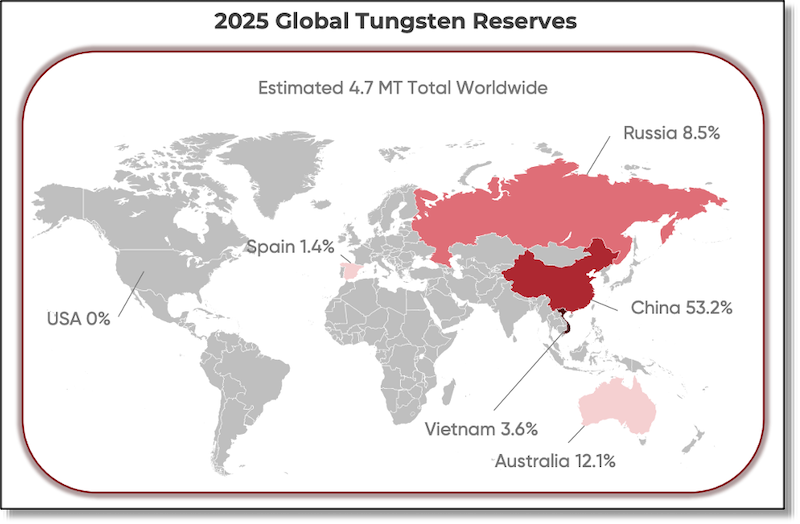 |
| The western world produces hardly any tungsten at all relative to nations like China and Russia.
|
| The next-largest reserve holders are Australia and Russia. Western supply is nearly nonexistent.
In fact, the United States produced exactly zero tungsten in 2025. Not a single mine, not a single pound.
And yet tungsten is everywhere that matters.
It has the highest melting point of any metal. It’s one of the densest elements on the periodic table.
|
| It’s irreplaceable in armor-piercing ammunition, jet turbine components, missile guidance systems and the cutting tools that manufacture everything from semiconductors to surgical equipment.
|
| There is no substitute for it in virtually any of its critical applications.
When the Pentagon says it needs a metal, it means it. And tungsten is at the top of that list.
Washington has also begun to act.
For metals deemed sufficiently critical to national security, the government has shown a willingness to lower the barriers to domestic production — streamlining permitting, fast-tracking environmental reviews and deploying financing mechanisms that simply don’t exist for ordinary mining projects.
Tungsten, given its irreplaceable role in defense applications, sits squarely in that category.
|
| America’s Tungsten Giant:
Right At Home
|
| A couple of months ago, Spartan acquired an option to earn 100% of the Victorio Tungsten-Molybdenum Project in Luna County, New Mexico.
This is an advanced-stage asset boasting roughly 100 existing drill holes...an historical positive Preliminary Economic Assessment from 2008...and a 2012 historical resource estimate that positions it as the largest tungsten resource in the United States.
|
| The historical figures are substantial: 77.2 million tonnes in the measured and indicated category grading 0.09% tungsten trioxide, plus 0.09% molybdenum.
That translates to over 130 million pounds of WO₃ and a comparable quantity of molybdenum in the higher-confidence categories alone.
|
| Another 77 million tonnes sit in the inferred category.
And that’s all before a pending updated economic study at today’s prices.
Now consider the impact of updating that study: When the original PEA was completed in 2008, tungsten was trading around $8 per pound. The work showed positive project economics even then and justified development at those metal prices.
With tungsten now well above $140 per pound, those economics shouldn’t just look better — they should look transformational.
And Victorio is also far more than a tungsten story.
|
| The deposit is a tungsten-molybdenum skarn carrying significant concentrations of beryllium, fluorspar and rhenium — each of them on the U.S. critical minerals list.
And none of them yet accounted for in any economic study.
|
| The updated resource and economic work now underway will incorporate all of these materials into the evaluation.
|
| The Study That Will Define The Opportunity
|
| Spartan has initiated a full update to the 2008 PEA at Victorio, along with a modernized mineral resource estimate encompassing tungsten, molybdenum, beryllium, fluorspar and additional critical minerals present throughout the deposit.
The study is expected to be completed in early Q4 of this year.
This will be a defining moment for Spartan and its shareholders — bringing Victorio’s economics to market for the first time at current metal prices and with a full accounting of its multi-mineral endowment.
|
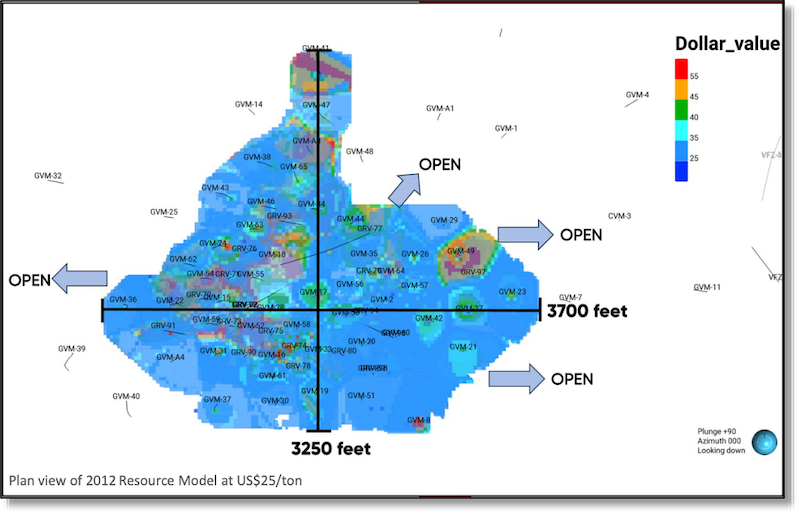 |
| The Victorio project is wide open for further exploration in areas directly adjacent to previously mapped mineralization.
|
| The resource at Victorio also remains open to the northeast, east and west, and there is meaningful critical mineral content identified above the current primary ore zone.
Note that some of the highest grades are directly on the borders of the previous drilling. In short, the deposit has room to grow, and more drilling will be part of advancing the project toward feasibility.
|
| Yet Another Project
— Where High Grades Do The Talking
|
| Spartan’s 100%-owned Eagle Project in the Kern Mountains of White Pine County, Nevada tells a different but equally compelling story.
Eagle covers 36.5 square kilometers in one of the most established mining jurisdictions in the world...hosting three past-producing mines that operated from 1915 to 1956 at grades between 0.6% and 0.9% WO₃, with some underground channel samples reaching above 5% WO₃.
By any modern standard, those are exceptional grades.
And Eagle is more than a tungsten story as well.
The district contains one of the most unusual critical mineral combinations in North America: high-grade silver and copper mineralization consistent with carbonate-replacement deposit geology, alongside a rubidium enrichment halo running into the thousands of parts per million across wide portions of the property.
Rubidium is one of the most strategically sensitive...and valuable...metals on U.S. defense lists.
|
| It is essential in atomic clocks, missile guidance systems and emerging quantum technologies that are the foundation for advanced artificial intelligence.
|
| However, it is almost never found in concentrations that make standalone recovery viable.
But at Eagle, the grades appear meaningful.
Add other defense critical minerals like antimony, bismuth and indium, and the picture that emerges is a critical minerals hub with tungsten at its center.
Spartan has now launched its 2026 exploration program at Eagle.
|
| Surface sampling is now underway across the expanded Tungstonia claim block, testing for additional tungsten, silver and rubidium anomalies and potential skarn mineralization.
Ground geophysics surveys follow in early June, imaging the subsurface to depths of more than 1,500 meters to better define how far the known vein systems extend at depth.
|
| That data feeds directly into a 3,000-meter diamond core drilling program set to begin in early to mid-July, with results expected through the fall.
|
| America’s Most Accessible Tungsten
|
| While Victorio represents the scale opportunity and Eagle the high-grade exploration upside, there is a third dimension to the Spartan story that could generate news flow well ahead of either.
|
| At the legacy Tungstonia mill site on the Eagle property, Spartan drilled the historic tailings pile and returned weighted average grades of 0.13% WO₃, 10.6 grams per tonne silver and 626 parts per million rubidium across 133 samples.
|
| Selected intervals reached 0.42% WO₃ alongside 123 g/t silver and over 1,180 ppm rubidium.
What makes this particularly compelling is what the tailings are — ore that is already mined and sitting on surface.
Metallurgical testwork now underway is evaluating gravity separation — a well-understood, low-cost processing approach that could yield strong recoveries. And the silver and rubidium credits alongside the tungsten only add to the potential economics.
|
| If the metallurgical results confirm what the grades suggest, the Tungstonia tailings could represent the fastest path to domestic tungsten output in the United States.
|
| And results from the metallurgical program are expected imminently.
|
| A Valuation That Hasn’t Caught Up
|
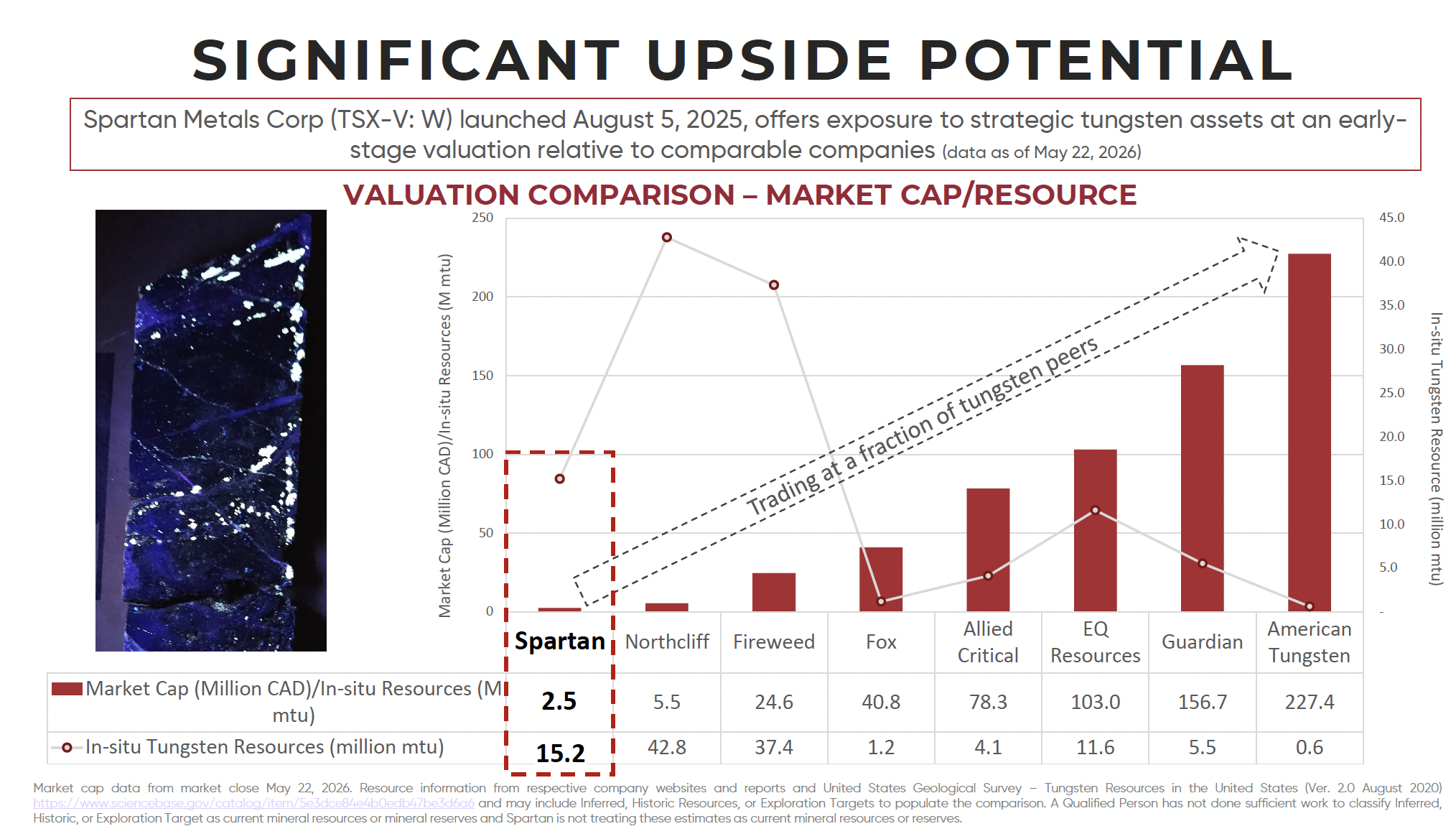
| Among tungsten-focused peers, Spartan’s market cap per metric ton unit of in-situ tungsten resource is the lowest of any company in the comparison.
|
| |
| Click image to enlarge
Compared to its peers, Spartan is currently trading at a mere fraction of the average value of its peers.
|
| Companies with smaller, lower-grade or less strategically situated resources trade at considerable multiples of Spartan’s current implied value.
The Victorio acquisition fundamentally changed the scale and strategic relevance of this company — and the market has yet to notice.
|
| It’s All Poised To Change...
|
| Most investors don’t realize that tungsten prices have risen about six-fold over the past year or so...and the structural forces behind that move are not resolving anytime soon.
There are no active tungsten mines in North America.
China’s grip on supply is, if anything, tightening as they banned all tungsten exports to western countries earlier this year.
And the U.S. government has made domestic critical mineral production a stated national security priority.
Against that backdrop, Spartan Metals controls:
|
- The largest tungsten resource in the United States,
- One of the highest-grade historic tungsten projects in North America,
- What may be the most accessible near-term tungsten production opportunity on the continent.
|
| An updated PEA for Victorio is expected later this year...drilling results from the Eagle Project are coming in September...metallurgical results from the Tungstonia tailings are imminent.
In other words, the window for smart investors to look into this story at an early-stage valuation could close soon.
|
| CLICK HERE
To Learn More About Spartan Metals Corp.
|


.png)