|
| Plenty of explorers would build an entire company around a 4.3-million-ounce gold-copper deposit.
|
| For Auro Metals (AURO.V; AURFF.OTC), that may only be the starting point.
|
| The fact is, seven rigs are now drilling to transform the scale of its Santa Barbara project in southeastern Ecuador — and the first results are expected any day.
|
| As you’re about to see, a hit in the right place does far more than just add ounces.
|
| A Summer Of Extraordinary Drill Results
|
| When Auro acquired Santa Barbara from Silvercorp Metals in May, it took on a porphyry deposit in the Zamora Copper-Gold Belt, 36 kilometers south of Lundin Gold’s massive Fruta del Norte mine.
|
| The current NI 43-101 resource holds 697,000 ounces of gold in the indicated category and another 3.42 million ounces inferred. With copper included, that’s roughly 4.3 million gold-equivalent ounces.
|
| That’s a world-class resource…and it rested on just 56 holes drilled between 1999 and 2018.
Auro’s Phase I program added 22 holes and 11,047 meters this year, focused on the southern core of the system. The intercepts were remarkable for their length and consistency:
|
- 705.7 meters grading 0.61 g/t gold and 0.10% copper, starting at surface
- 625.12 meters grading 0.64 g/t gold and 0.10% copper
- 496.5 meters grading 0.76 g/t gold and 0.12% copper, including 212.5 meters at 1.12 g/t gold
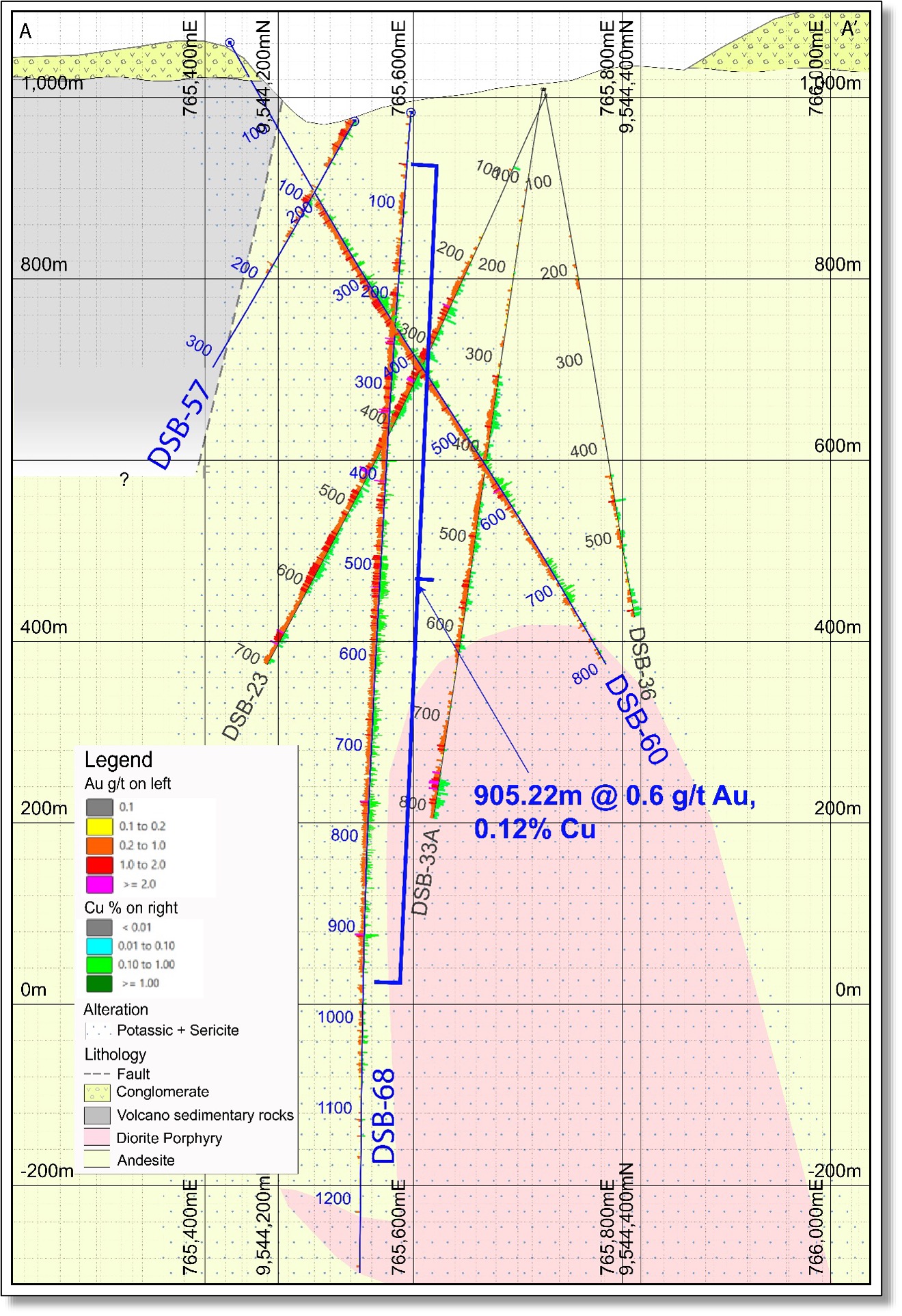
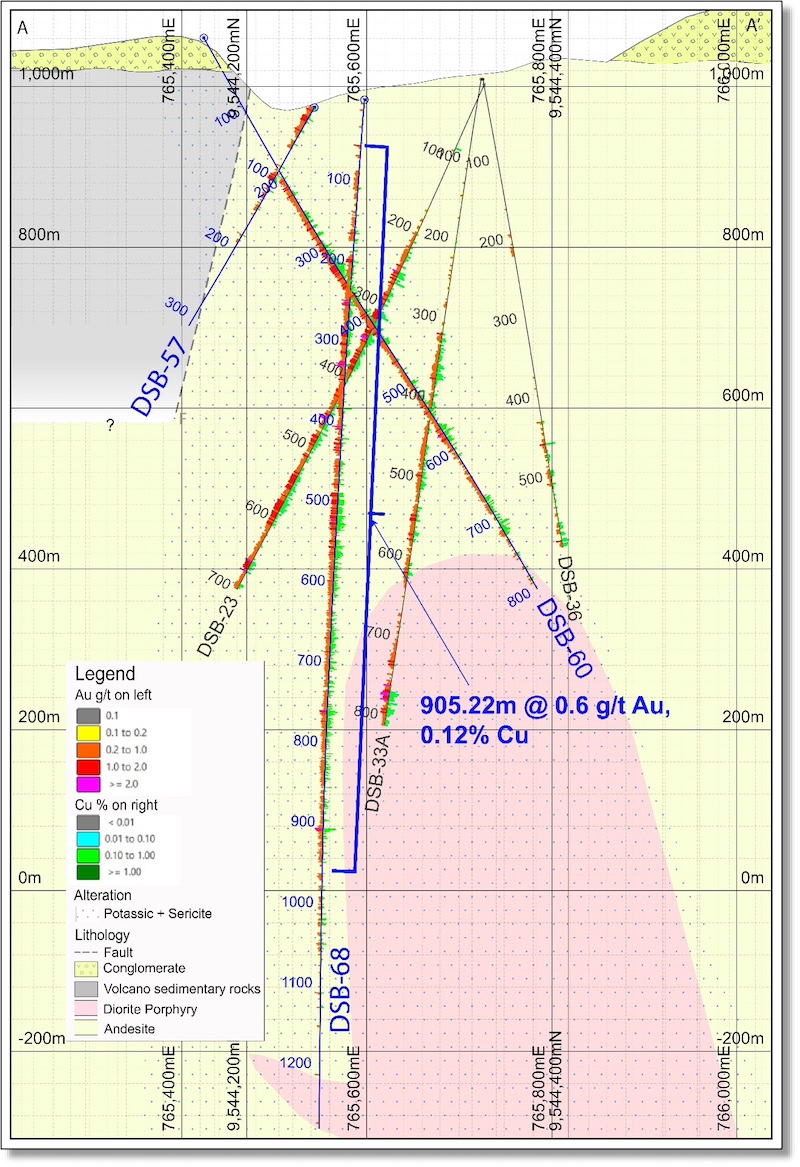
- 905.22 meters grading 0.60 g/t gold and 0.12% copper
|
| Simply extraordinary lengths…and every one of these intercepts begins within roughly 90 meters of surface.
That last hole reached 1,282 meters, the longest and deepest ever drilled at Santa Barbara. It returned the best reportable intercept in the project’s history — and was still in mineralization when the rig hit its limit.
|
 |
| Click image to enlarge
The deepest hole ever drilled at Santa Barbara was still in mineralization when it stopped.
|
| Results are out for 17 of the 22 Phase I holes, with five still to come.
|
| Why The Gaps Matter So Much
|
| You see, the current resource takes in several separate zones of mineralization. Between them lie stretches of rock that have seen little or no drilling.
|
| In the resource model, that rock is carried as waste. It has to be moved to reach the gold and copper, and it contributes nothing in return.
|
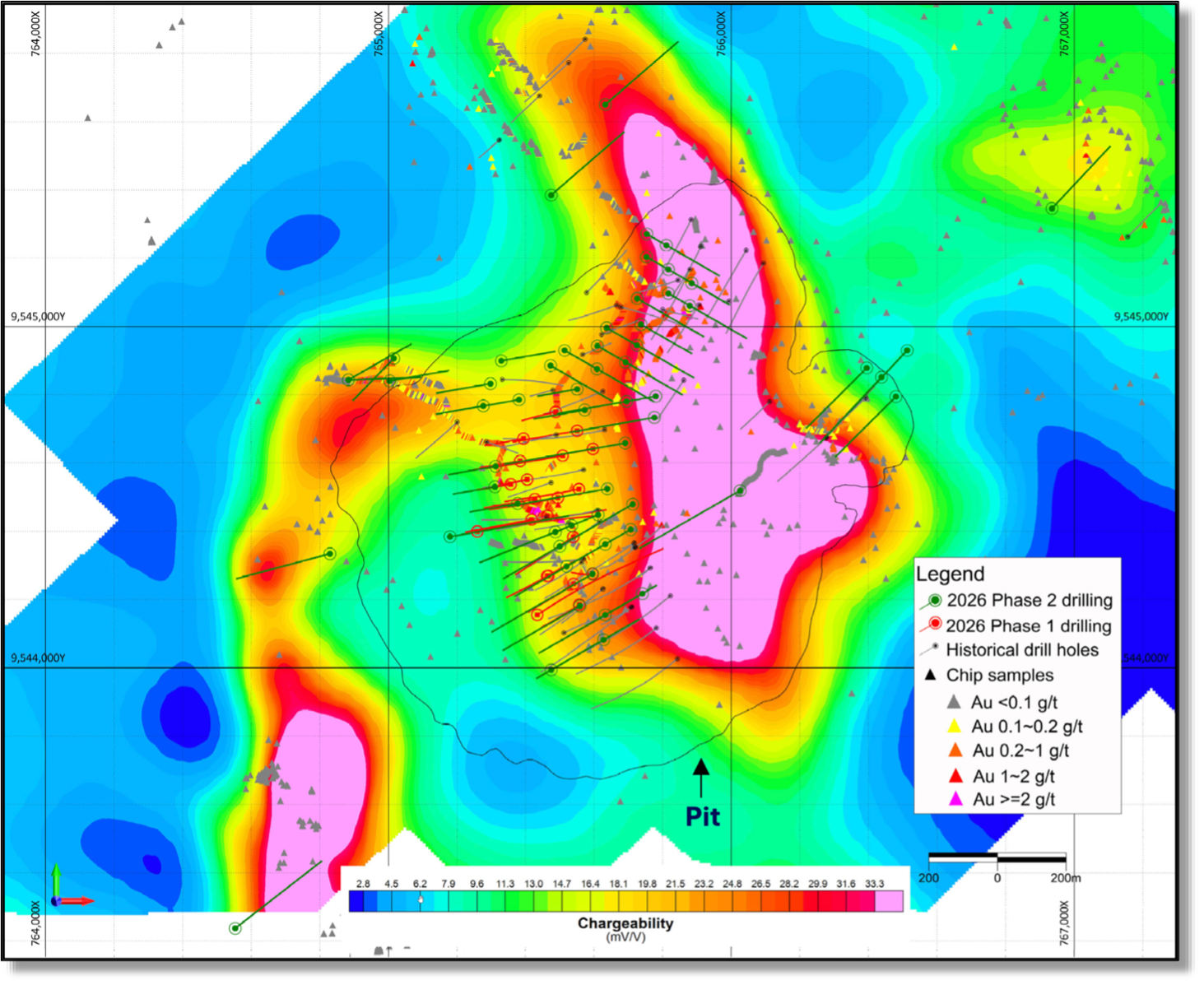
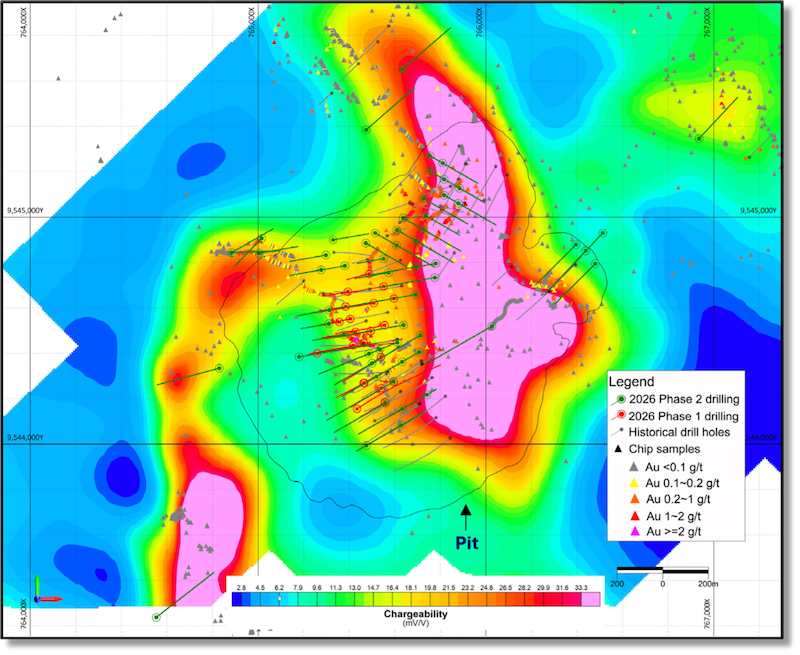
| Phase II starts by drilling straight into those gaps. And the targeting has geophysics behind it: A historical IP survey shows a chargeability anomaly lining up with the same ground.
|
 |
| Click image to enlarge
Phase II drilling will fill in the gaps between known zones — and those gaps line up with a major IP anomaly.
|
| If the gaps prove to be mineralized, two things happen at once:
|
| Rock now counted as waste becomes resource….and the strip ratio, the amount of waste moved for every tonne of ore, comes down for the entire deposit.
|
| The company views this as a potential inflection point, one that could substantially increase the resource within the existing pit shell alone.
|
| Wider Means Deeper...
|
| Then comes the second effect.
An open pit can only go as deep as its width allows. Widen the footprint and the pit can reach farther down.
|
| That matters enormously here, because Phase I showed mineralization reaching more than 1,000 meters below surface, including 905 continuous meters in a single hole. A broader pit could bring more of that deep material into play.
|
| So Phase II goes well beyond the gaps. Drills are also stepping out around the current pit shell toward targets defined by historical rock-chip sampling and IP chargeability anomalies, testing the known zones at depth and adding infill holes ahead of a future resource update.
To do it, Auro is expanding from four rigs to seven. And each of the three new rigs can drill deeper than 1,000 meters.
|
| A Steady Stream Of Catalysts
|
| Put plainly, Auro is entering the busiest stretch of news in its history.
The first Phase II assays are expected any day. The five remaining Phase I holes are still to be reported. Metallurgical test work begins this month. And a Phase III program is planned to follow directly on from Phase II.
Auro plans to reach 50,000 meters of drilling by the end of the first quarter of 2027. With Phase I accounting for just 11,047 meters, that leaves a lot of drilling (and a lot of drill results) still to come from Phases II and III.
Once that work is done, the plan is an updated resource and a preliminary economic assessment. Every step along the way decreases risk and builds value.
There is plenty of room to grow an already massive resource. Mineralization remains open up-dip, down-dip along strike and at depth, and the 55.3-square-kilometer property extends well beyond the area drilled so far.
|
| A Deposit Still Being Measured
|
| So what is all of this worth today?
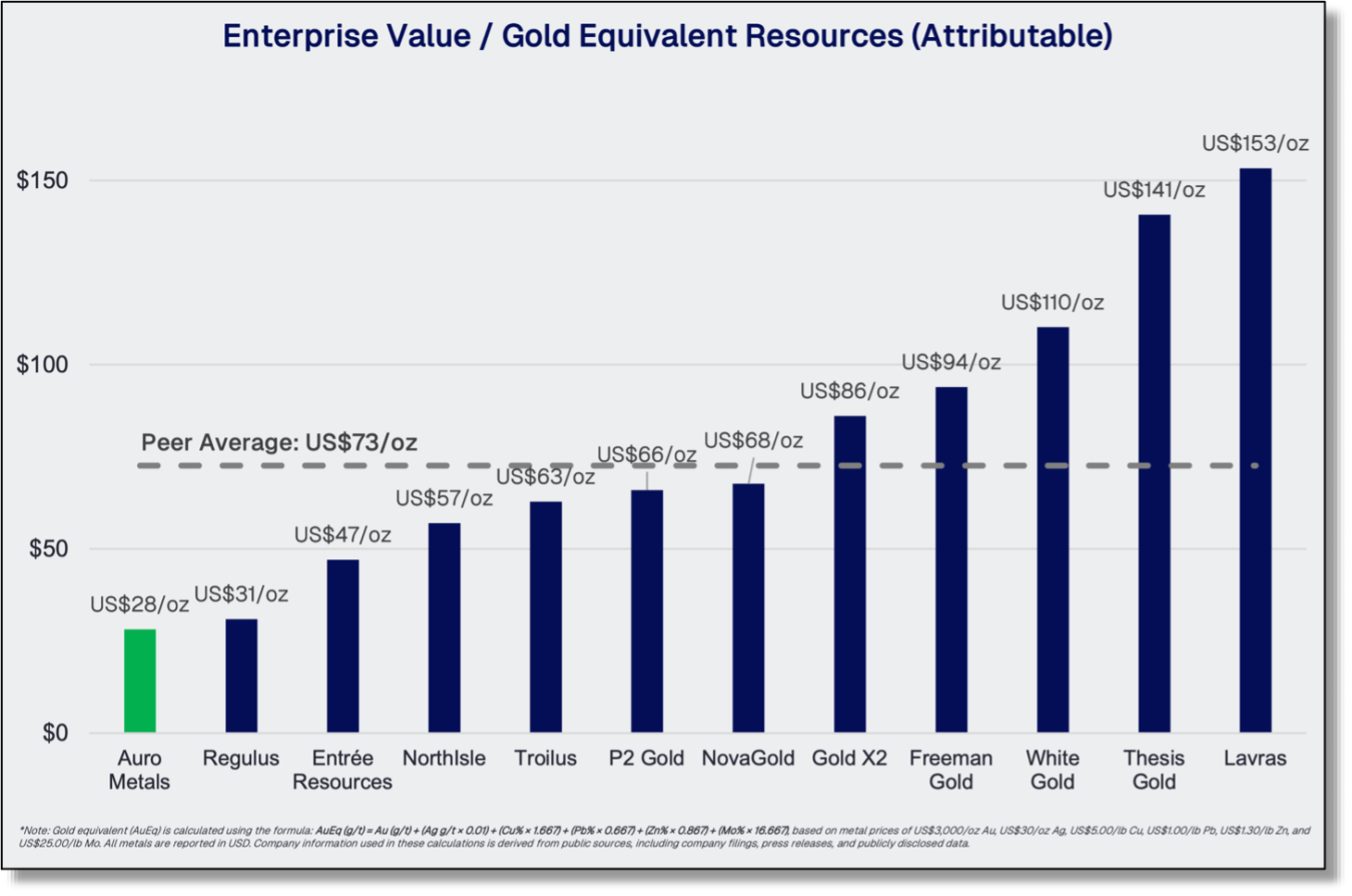
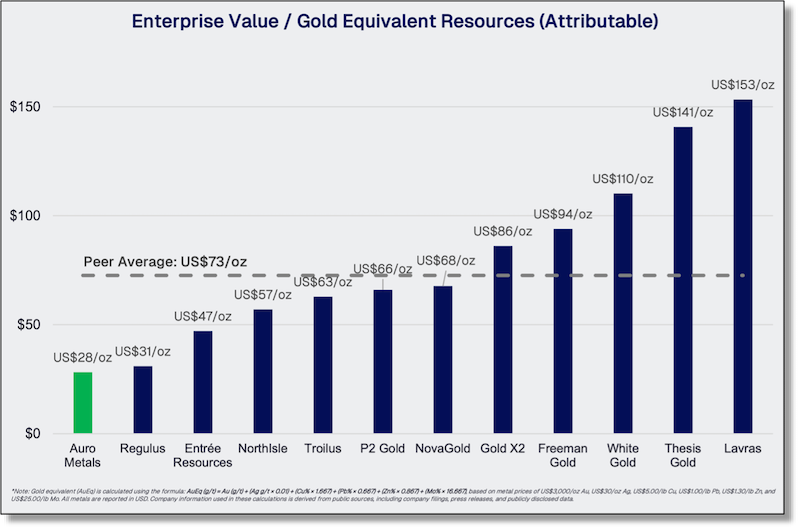
On the company’s own peer comparison, Auro’s enterprise value per gold-equivalent ounce comes in at less than half the peer average of $73.
|
 |
| Click image to enlarge
Auro's enterprise value per ounce sits at less than half the peer average, and that's before this year's drilling is counted.
|
| And that figure is measured against the 4.3 million ounces in the current estimate, which includes none of this year’s drilling. Phase II is aimed squarely at making that number significantly larger.
The neighborhood matters too. Ecuador has seen over $1.5 billion in M&A activity in the past two years, as major acquirers moved on its large copper-gold porphyries.
|
| Auro also has the backing of Silvercorp Metals, a major shareholder, and the guidance of Silvercorp founder Dr. Rui Feng. This is a group that has taken projects from discovery to profitable production before.
|
| Seven rigs are turning. The first results from the most important ground on the property are days away. And the true size of Santa Barbara is still an open question.
Now is the moment to get to know Auro Metals.
|
| CLICK HERE
To learn more about Auro Metals
|


.png)