|
| In the life of every major gold discovery, there is a moment when the story shifts.
|
| That’s not when the first gold is hit by the drill bit, but rather when drilling confirms scale, continuity and the potential for something much larger than the market currently believes.
|
| That moment may be unfolding right now at Tiger Gold (TIGR.V).
|
| Just weeks after publicly listing, Tiger has begun delivering the kind of drill results that command attention: long, near-surface gold intercepts, grades coming in above the existing resource model and geological indicators suggesting the system may be strengthening at depth.
All of this is happening in one of the world’s most prolific and rapidly re-emerging gold districts.
|
| ...And because this is a brand-new story in a fast-moving market, Tiger Gold has been largely overlooked.
|
| As you’re about to see, that’s not likely to last much longer....
|
| A Land Of Giants
|
| Tiger Gold is not a grassroots exploration play — no matter what its still-low valuation might imply.
Not only is the company coming to market with real ounces...a PEA with real economics...and drills already turning focused on adding more ounces...it stands as the latest play in an established trend of world-class gold deposits.
|
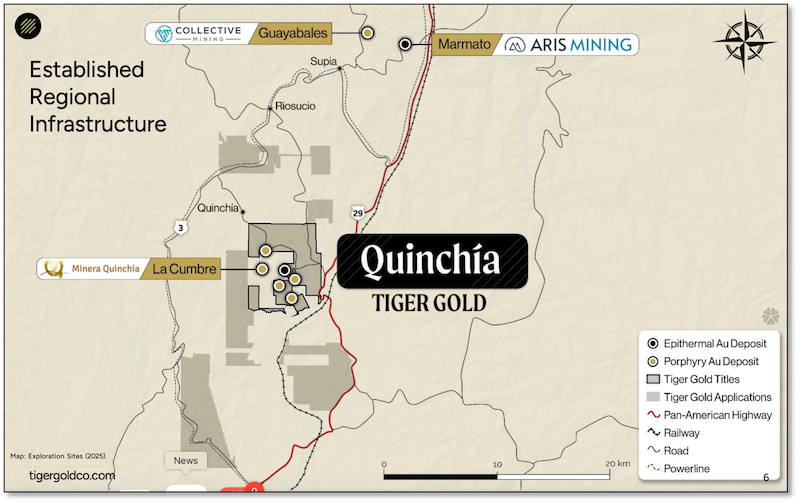 |
| Tiger Gold is coming to market with an already-established suite of projects in the midst of one of the world’s hottest discovery districts.
|
| The company’s Quinchía Gold Project is located in Colombia’s Mid-Cauca porphyry belt, which has emerged as one of the most productive gold and copper-gold regions in the entire Americas.
This belt is home to multiple world-class gold deposits and operating mines, including:
|
| • Marmato (Aris Mining) – approximately 6 million ounces of gold and 11 million ounces of silver
• La Colosa (AngloGold Ashanti) – roughly 28 million ounces
• Nuevo Chaquiro (AngloGold Ashanti) – around 7 million ounces
• Gramalote (B2Gold) – over 5 million ounces
• Buriticá (Zijin Mining) – more than 5 million ounces of gold, plus silver
|
| That’s elite company...with market valuations ranging from hundreds of millions to billions of dollars.
Tiger is far from those levels, of course. But it’s in the right place...with over two million ounces of current NI 43-101 compliant gold resources...and drills that are finding more almost every day.
In fact, at this very moment the company is demonstrating how large its own share of this district can become.
|
| Millions Of Ounces Already — And Growing
|
| Just because it’s new to the market doesn’t mean Tiger Gold is an unproven exploration story.
Far from it: Tiger came public a few weeks back with a substantial gold inventory already defined, some of it supported by a Preliminary Economic Assessment that outlines a credible, large-scale and profitable development scenario.
|
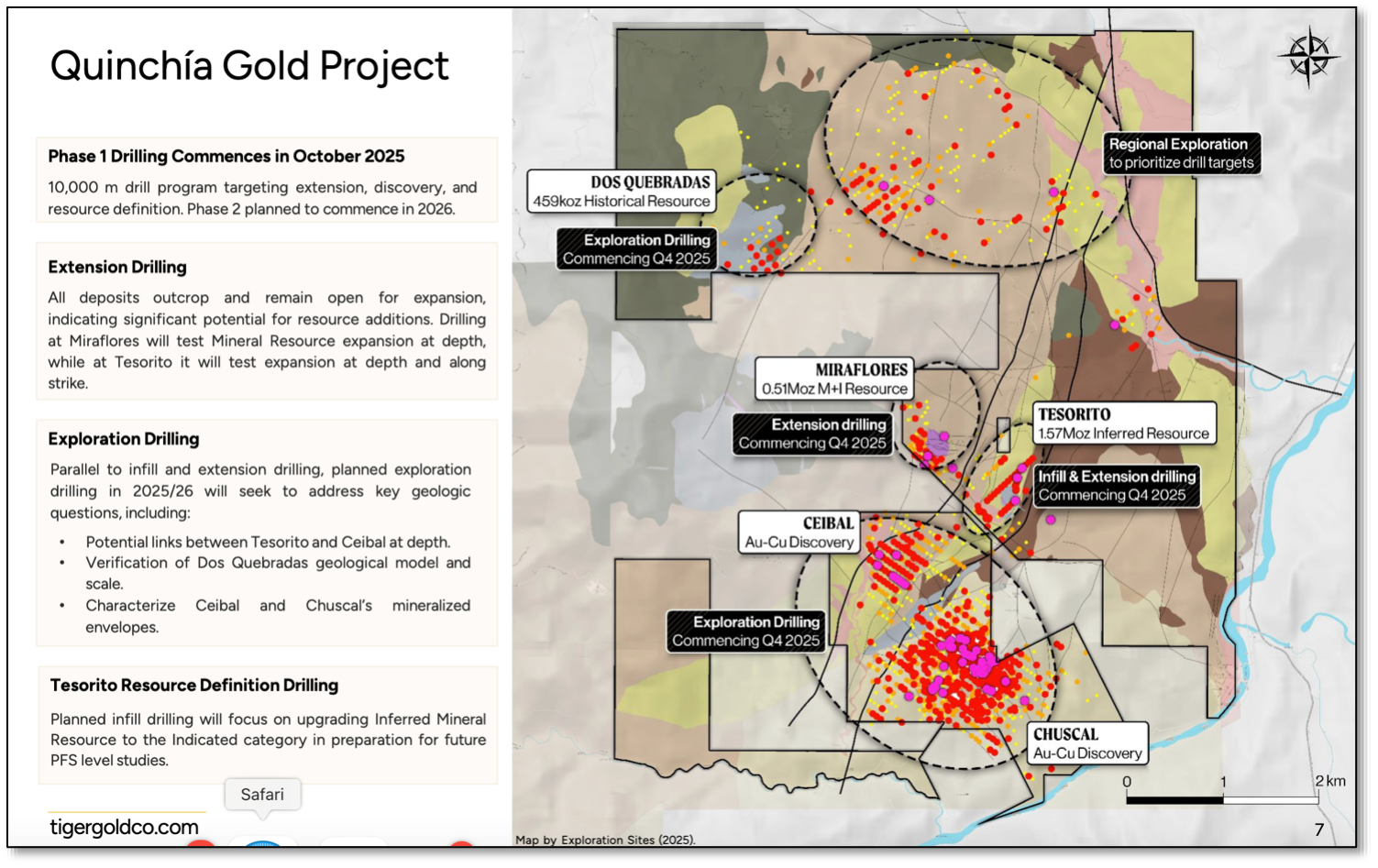
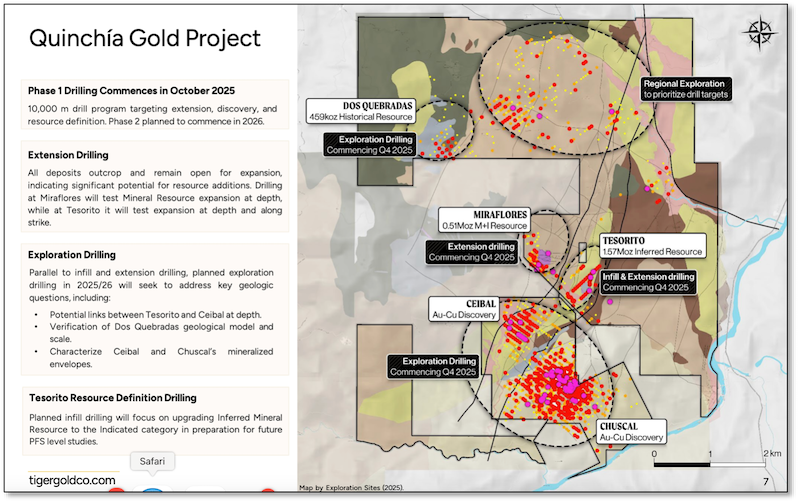
| Consider this: At Quinchía, the company has already outlined roughly 1.57 million ounces of inferred gold at the Tesorito deposit in a broad, open-pittable system...plus approximately 510,000 ounces of measured and indicated gold at Miraflores grading more than 2.6 g/t.
On top of all that, add an historical estimate of nearly 500,000 ounces at Dos Quebradas that provides even more upside as drilling resumes.
|
| That multi-million-ounce foundation alone is worth a lot. And it alone could drive Tiger’s market value considerably higher as investors continue to discover this story.
|
| But Tiger’s management isn’t counting on that: They’re already using the drill bit to find even more gold.
|
 |
| Click image to enlarge
Drills are already turning to expand Quinchia’s two-million-ounce resource, with numerous identified targets clearly established.
|
| Big Surprises In Early Drilling
|
| Tiger’s initial 10,000-meter Phase 1 drill program is underway, and the first results from Tesorito are already exceeding expectations.
|
| Early holes returned long, continuous gold intercepts starting near surface, with grades well above the current average resource grade of 0.47 g/t gold. One hole intersected nearly 140 meters at 0.9 g/t gold, including intervals that exceeded the existing block model in a sparsely drilled area.
|
| Another hole delivered broad, near-surface mineralization, followed by a second mineralized zone at depth that included higher-grade internal intervals. These results support both the continuity of the system and its potential to grow beyond the current model.
Then came a result that truly stood out.
A subsequent hole intersected more than 300 meters of continuous gold mineralization, including over 80 meters grading 1.4 g/t gold, and ended in mineralization. Intercepts of that scale are difficult to ignore and are rarely accidental.
|
| Signs Of More At Depth
|
| Equally important, Tiger’s geologists observed increasing sulphide intensity and elevated chalcopyrite at depth in the same hole, a classic indicator of proximity to a potential mineralizing feeder zone.
|
| In plain terms, the geology suggests that the system may not only be large, but could also improve as drilling pushes deeper. That is exactly the kind of signal that often precedes the discovery of higher-grade cores within large porphyry-style gold systems.
|
| With assays still pending from multiple additional drillholes, the company expects a steady flow of results in the weeks ahead.
|
| Multiple Rigs, Multiple Targets,
Multiple Shots On Goal
|
| Two drill rigs continue to operate at Tesorito, focusing on infill and extension drilling designed to upgrade inferred ounces and expand the current resource footprint.
At the same time, a third rig has been mobilized to Dos Quebradas, a high-priority target located several kilometers from the main deposits.
|
| Dos Quebradas hosts an historical resource of roughly 460,000 ounces, and Tiger believes modern drilling and modeling could unlock much more gold across this underexplored area.
|
| This highlights another aspect of Tiger Gold that the market is about to realize: This has never been a single-deposit story. This company is proving up a district-scale gold system...and one that is being drilled aggressively.
|
 |
| Click image to enlarge
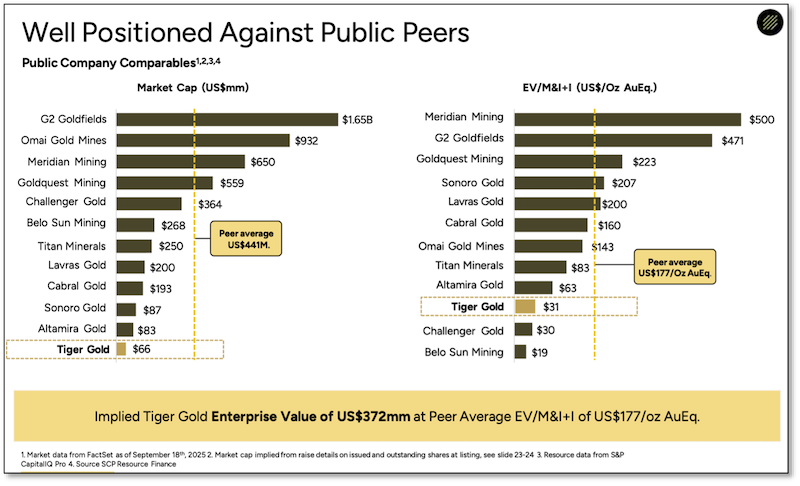
As a newly listed public company, Tiger Gold is currently valued at a mere fraction of the valuations of its peer companies.
|
| A Valuation That Is Currently Out Of Sync
|
| Despite the scale already defined and the momentum now building, Tiger Gold remains valued as if little of this progress matters.
|
| Consider this: The company’s PEA outlines average annual production of approximately 140,000 ounces of gold, generating an after-tax net present value of about US$534 million at a gold price of just US$2,650 per ounce.
At higher gold prices, the projected NPV climbs well above US$1 billion.
|
| Yet Tiger’s current market value remains under approximately US$53 million, implying a valuation of roughly US$25 per ounce of gold in the ground, without giving any credit to the historical resources.
That’s a mere fraction of the valuation that comparable companies in similar jurisdictions and development stages command.
That kind of disconnect tends to close quickly once drilling results and market awareness begin to compound.
|
| Why This Window Matters
|
| Tiger Gold is newly listed, still relatively unknown and only just beginning to demonstrate the true scale of its assets.
|
| The company already hosts millions of ounces, is delivering better-than-modeled drill results, has multiple rigs turning, and is starting to see geological signals that point toward much, much more.
|
| These are the moments when the market starts to re-rate a story...and opportunities like this rarely stay quiet for long. Click on the link below to begin your due diligence on Tiger Gold while you still can.
|
| CLICK HERE
To Learn More About Tiger Gold
|


.png)