|
| When a junior finally becomes a producer, the market usually doesn’t miss it.
|
| The problem is that the best setups often look “too ordinary” in the moment. A mine restarts, the mill runs, the first steady ounces come out, and investors assume it will take quarters or years before anything truly changes.
|
| That’s why West Red Lake Gold Mines Ltd. (WRLG.V; WRLGF.OTC) is worth a close look right now.
|
| You see, on January 1, 2026, West Red Lake declared commercial production at its 100 percent owned Madsen Gold Mine in Ontario’s Red Lake district. This is one of the few genuinely new gold production stories to emerge in a market that has been short on new mines.
Yet in all the new year excitement over the soaring gold price (and the subsequent correction), the market seems to have missed the emergence of this remarkable new gold mine — and the potential it now provides for investors.
|
| No More Projections:
Rich Gold Now Flowing To The Bottom Line
|
| West Red Lake’s update announcing production was not vague and it was not promotional. It came with operating metrics that matter.
In December 2025 the mill averaged 689 tonnes per day, which is 86 percent of the permitted 800 tonnes per day. Recoveries averaged 94.6 percent and the operation produced 3,215 ounces of gold during the month.
For the fourth quarter of 2025 the mine produced 49,162 tonnes of ore, averaging 534 tonnes per day, at an average grade of 5.06 g/t gold with 95 percent recovery. The company reported 7,379 ounces of gold produced in the quarter and 7,200 ounces poured.
|
| Here’s the remarkable part: Those poured ounces were sold at an average price of about US$4,150 per ounce for total gold sales revenue of roughly US$30 million in the quarter.
|
| That is not a “one day we might” story. That is revenue.
West Red Lake also reported that in 2025 it poured 20,000 ounces of gold, sold at an average price of about US$3,650 per ounce for total gold sales revenue of roughly US$73 million. It finished 2025 with about C$46 million in cash and gold receivables.
This is what the market rewards: proof.
|
| A Different Approach Than The Last Operator
|
| Madsen carries baggage because the previous operator rushed to production and stumbled. West Red Lake took the opposite approach, and it shows in how the restart has unfolded.
Management emphasized a responsible and methodical ramp up, built on bulk sampling, careful mine planning and a focus on operational stability.
|
| Commercial production was declared only after internal requirements were met, including 30 consecutive days of mill throughput at 65 percent or greater of permitted capacity.
|
| It is a subtle distinction, but a critical one. In mining, discipline is often the difference between a restart that sticks and a restart that becomes a cautionary tale.
|
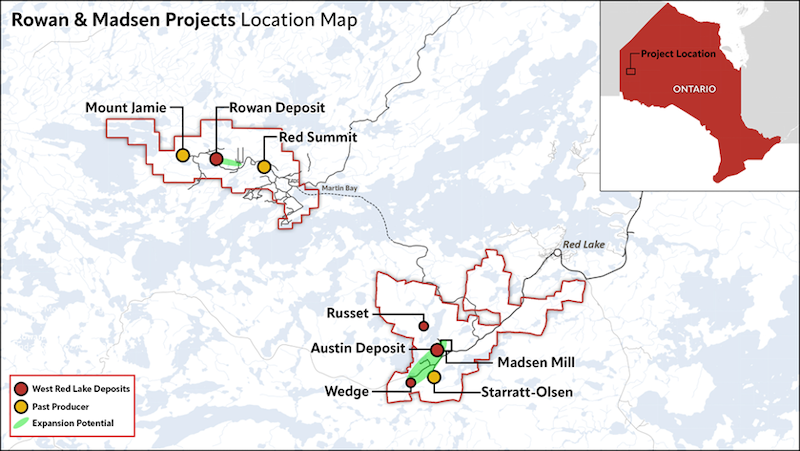 |
| With multiple growth targets already defined, West Red Lake Gold Mines Ltd. (TSXV:WRLG.V; WRLGF.OTC) is positioned to move rapidly from brand new mine into a multi-year production buildout.
|
| Look What They’re Feeding The Mill Now
|
| West Red Lake has also been clear about what is driving near-term performance.
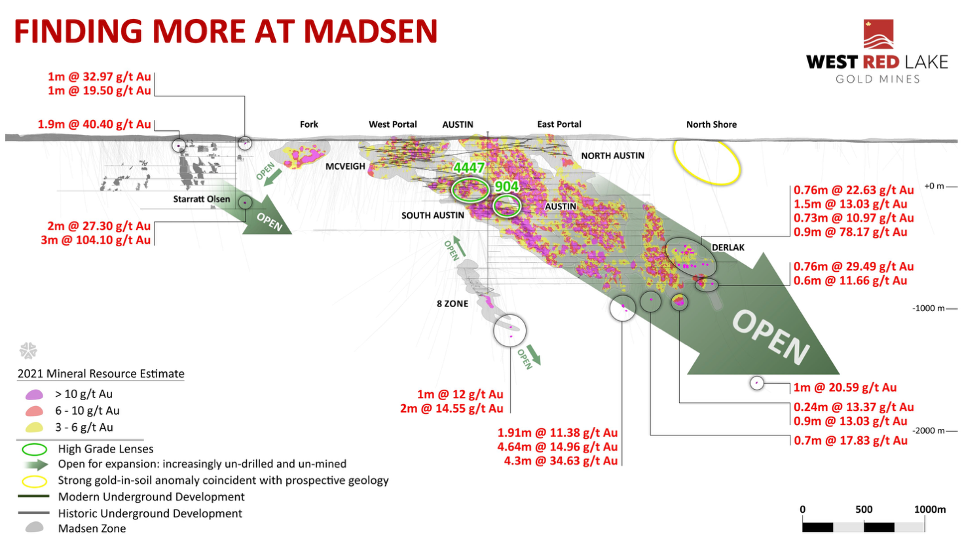
For the first quarter of 2026, mill feed is expected to come predominantly from the 4447 area, described as a high-grade zone in South Austin that the company defined in 2025.
|
| Management also noted that material from 4447 lifted the gold grade through the Madsen mill to levels reaching 8.9 g/t gold in December, even as the month’s average head grade was reported at 4.94 g/t gold.
|
| The takeaway is straightforward: The mine is running, the mill is performing and the company is prioritizing higher-margin material as it ramps.
|
| The Catalysts Stack Up From Here
|
| Commercial production isn’t the end of this story — it’s the beginning of the phase when markets tend to assign a different multiple.
West Red Lake expects to provide 2026 guidance during the first quarter. It also stated that it anticipates reaching sustained permitted capacity by mid-2026.
At the same time, management is already working on multiple avenues that could expand the production profile over time.
|
| The company has spoken about drilling at the Fork deposit with the goal of bringing that into the mine plan. It has also referenced a developing high-grade area in Lower Austin called the 904 Complex that it compares to 4447 in terms of “jewelry box” style high-margin mineralization.
|
| A producer that is already thinking about the next source of higher-grade feed tends to get a different audience in this market.
|
| |
| Click image to enlarge
The current and growing production is only part of the story for West Red Lake — the potential for growth at Madsen is exceptional as the trend to depth is clear.
|
| Rowan Adds A Second Engine
|
| The other reason this story is getting more interesting is Rowan.
On January 29, 2026 West Red Lake reported first-round infill drilling results from its fully funded drill program at the Rowan Project in Red Lake. A total of 38 holes for about 6,000 meters is planned, with 33 completed at the time of the release.
The early assays included multiple high-grade one-meter hits, including:
|
| Hole RLG-25-192b: 1 meter at 141.5 g/t gold on Vein 013, plus 1 meter at 17.55 g/t gold on Vein 011
Hole RLG-25-190: 1 meter at 55.8 g/t gold on Vein 006, plus 1 meter at 12.5 g/t gold on Vein 013
|
| The company described visible gold associated with quartz veining and silicification in several of these intercepts. It also noted that its updated mineralized domain model has been holding true, with veins intercepted where expected.
Importantly, management said these results are expected to provide meaningful data for an updated mineral resource estimate at Rowan planned for the second quarter of 2026. Based on early success, the company added an additional 1,000 meters of drilling to continue extending Vein 001 along strike to the west in previously undrilled areas.
This is exactly how growth gets built in real time: confirm continuity, tighten the model, expand methodically and feed the next study.
|
| Why The Market Disconnect Matters
|
| In a stronger gold tape, the market has often paid premium valuations for companies that are still years away from first production. That can make sense when pipelines are scarce, but it also creates a blind spot.
|
| The blind spot is the company that has already done the hard part.
|
| West Red Lake is now a commercial producer in one of Canada’s best-known gold districts, with a running mill, a funded balance sheet and active drilling that can support both mine optimization and future growth.
The market will not ignore those inputs forever — especially once formal guidance arrives and investors can start benchmarking real throughput, real grades and real recoveries.
|
| And if you want the simplest version of the thesis, it is this: Proof tends to change everything.
|
| West Red Lake has moved from “can they do it” to “how far can they take it.”
|
| CLICK HERE
To Learn More About West Red Lake Gold Mines
|


.png)