|
| Sometimes things don’t work out the way you planned.
|
| Sometimes they turn out much better than you would have ever imagined.
That’s what happened for tiny junior exploration company Ramp Metals (RAMP.V) in the summer of 2024.
|
| And now, it may be what’s about to happen for its shareholders in the weeks just ahead.
|
| Because the story of Ramp Metals’ amazing and unexpected gold discovery has three chapters so far — and the third chapter, being written at this moment, seems to be where all the plotlines are coming together.
|
| Chapter 1:
Finding Gold In The Most Unlikely Of Places
|
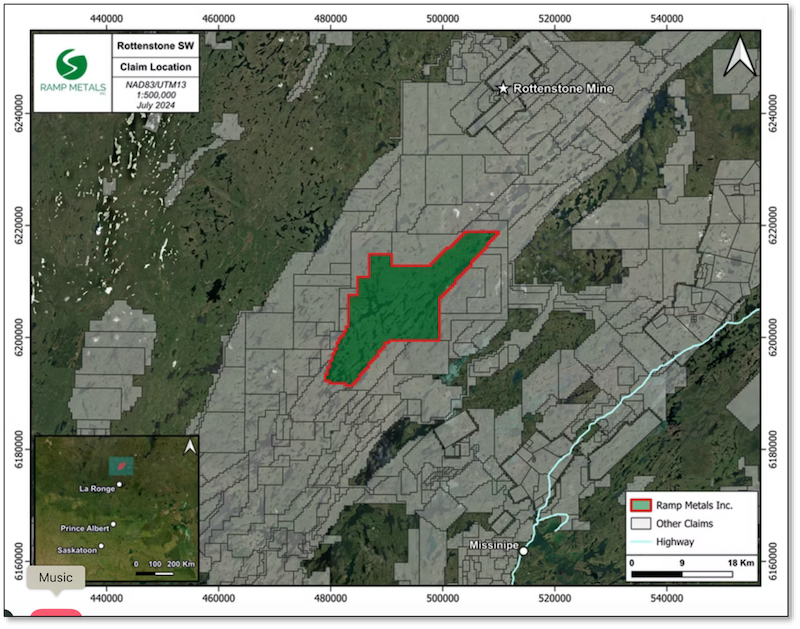 |
| Ramp controls an extensive, 32,715-hectare land position near and on trend with the historic Rottenstone mine, one of Canada’s richest polymetallic producers.
|
| In 2024, Ramp Metals began with a very straightforward idea: Follow a fertile regional trend extending from the historic Rottenstone Mine in Saskatchewan, which produced 40,000 tons of high-grade nickel-copper-PGEs-plus-gold ore grading 3.28% nickel, 1.83% copper and 9.63 g/t combined platinum-palladium-gold.
|
| Those grades would be extraordinary for a single drill intersection. For an entire mine to average such rich ore...well, it’s obvious why Ramp’s team was searching for another one.
|
| They were able to tie up the Rottenstone SW property — an exceptionally large, 32,715 -hectare land position sitting along the same northeast-southwest structural corridor — and management was able to raise just enough money to poke four holes to test their ideas.
They were also running out of time. And when both money and time ran out in the 2024 exploration season, they had managed to drill just 1,180 meters across those four holes.
Three of those four holes intersected mafic-ultramafic lithologies and pyrrhotite mineralization, exactly the kind of signs you’d want to see in a hunt for magmatic sulphides. In other words, the original nickel thesis wasn’t crazy at all.
What was crazy came with Ramp’s Ranger-01 hole....
|
| Instead of a headline nickel hit, it delivered a stunning gold intercept: 73.55 g/t gold and 19.50 g/t silver over 7.5 meters from 227 to 234.5 meters depth, including 164 g/t gold over 1.5 meters and 182 g/t gold over 1.5 meters.
|
| It doesn’t get much better than that. And not surprisingly, the market noticed.
Ramp quickly followed that discovery with a C$4.5 million financing led by Eric Sprott, then upsized and closed it for roughly C$4.94 million with support from Sprott and EarthLabs.
Suddenly the company had capital, visibility and a genuine discovery story. Investors were excited to see what would happen when Ramp came back the next season to drill around Ranger and test additional targets across the property.
And that’s where the story gets more interesting.
|
| Chapter 2:
Where Did The Gold Go?
|
| With money, a discovery and enticing new targets outlined by geophysics, the 2025 follow-up campaign was ambitious.
Ramp completed 20 holes totaling 4,942 meters, with eight holes at Ranger, 10 at the newly identified Rush target and three at the Rogue anomaly, while also flying high-resolution Xcite HTDEM geophysics over the property.
|
| Then came news, early in the program, that each of the first three Ranger follow-up holes had intersected the same quartz diorite intrusion that hosted the original high-grade gold. Expectations were at a fever pitch.
|
| Remarkably, the remaining Ranger holes failed to return significant gold...with results up to just 0.143 g/t gold over 1 meter in later reported drilling.
The company also said no significant gold values were intercepted in the remaining holes from Ranger and Rogue, although weakly elevated copper, zinc and silver values, sulphides and alteration suggested the team may have been on the edge of something larger.
In plain English, Ramp had the discovery hole — but not yet the geological model to repeatedly find the source.
|
| That uncertainty hurt. But it may also have been exactly what the company needed.
|
| Because while the market focused on the miss at Ranger, Ramp kept doing the work. It expanded the Rottenstone SW land package to 32,715 hectares, completed more prospecting and soil sampling, identified new targets and brought in much more sophisticated geophysics.
|
| Chapter 3:
Cracking The Code
|
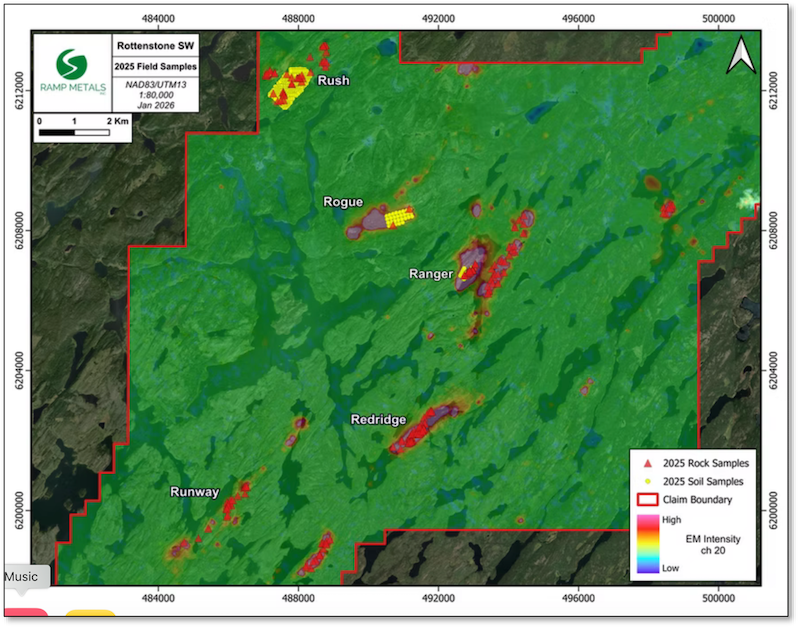 |
| Cutting-edge geophysical surveys, combined with soil and rock sampling, has outlined a number of high-profile targets...including high-grade discoveries...so far.
|
| At Rush, that work paid off with a brand-new VMS discovery, where first-pass drilling intersected mineralization in nearly every hole along a 1,200-meter conductor.
Highlights included 1.21% copper, 9.34% zinc and 5.59 g/t silver over 3.53 meters in Rush-001, 0.44% copper and 3.44% zinc over 23.7 meters in Rush-002 and 0.78% copper, 1.91% zinc, 0.53% lead and 12.71 g/t silver over 27 meters in Rush-010.
|
| Not as spectacular as the Ranger discovery hole, but not bad...and perhaps a taste of much better to come.
|
| Ramp now has three seasons of prospecting data, with cutting-edge geophysical surveys including airborne EM, ground FLTEM and borehole EM helping to put the puzzle pieces together....
|
| • At Rush, borehole EM generated multiple “Maxwell plate” models, with the company noting that the plates from Rush-001 and Rush-009 correlate well with mineralized intercepts and that most of those plates remain untested.
• At Ranger, a newly exposed 50-to-70-meter-wide shear zone with strong alteration, sulphides and quartz veins up to 1.5 meters wide was identified during the 2025 field season and is now part of the targeting picture.
• Meanwhile, the new Redridge and Runway anomalies have added yet more targets, including Redridge soil values up to 245 ppm copper and 852 ppb silver and a Runway grab sample with platinum, palladium and nickel anomalism.
|
| This is the real inflection point.
By management’s account, the team now believes it has finally “cracked the code” on what it was seeing at Rottenstone SW. And whether that means a better handle on the structural controls at Ranger, stronger vectoring from borehole geophysics or a broader understanding of how the gold and VMS systems relate across the property, the practical takeaway is the same:
|
| This next drill campaign should be much different than the last two.
|
| Consider this: The company is fully permitted through December 2027 for up to 150 drill holes, is permitted for 30,000 additional meters of drilling and had about C$4.5 million in treasury as of mid-January.
It mobilized a drill rig on February 23 and is targeting Rush, Ranger, Redridge and Runway. Even more enticing: After the excitement over that massive discovery hole has abated, Ramp’s current market cap is back under C$20 million.
|
| That seems the kind of setup speculators should pay attention to.
|
| You have a second shot at a story that’s already proven it can multiply in value on a single drill hole...a geologic team that has now employed state-of-the-art prospecting tools to crack the code of the geology and unearth even more targets...
And the drills are turning at this moment.
|
| CLICK HERE
To Learn More About Ramp Metals
|


.png)


