|
| A century ago the world’s most powerful industrial fortunes were built in oil refineries.
|
| John D. Rockefeller understood something his competitors didn’t: Controlling the wells mattered...but controlling the refineries mattered more.
|
| Because whoever refined the oil ultimately controlled the market.
|
| Today we may be witnessing a similar moment unfolding in rare earth elements.
These materials sit quietly inside the most important technologies of the modern economy: fighter jets, precision weapons, advanced robotics, electric vehicles, wind turbines and AI-driven infrastructure.
And while the elements themselves are widely distributed across the earth’s crust, the real bottleneck is what happens after they are mined.
Processing...separation...metallization...magnet manufacturing.
Those steps determine whether rare earths actually become the advanced materials modern industries depend on.
And today, China dominates nearly every stage of that process.
|
| The Processing Bottleneck The West Ignored
|
| For decades Western countries focused largely on the mining side of the rare earth equation.
But mining alone doesn’t solve the strategic problem.
|
| Rare earth ores must go through complex chemical separation, metallurgical reduction and advanced manufacturing before they become the permanent magnets and specialty alloys used in defense systems and high-performance electronics.
|
| And that’s where China built a massive lead.
The result is a supply chain vulnerability that policymakers increasingly describe as a national security risk.
You see, the United States currently depends heavily on overseas supply for many critical rare earth materials, particularly the high-performance metals used in advanced magnets and defense systems.
Which is exactly where REalloys (ALOY.Nasdaq) enters the story.
|
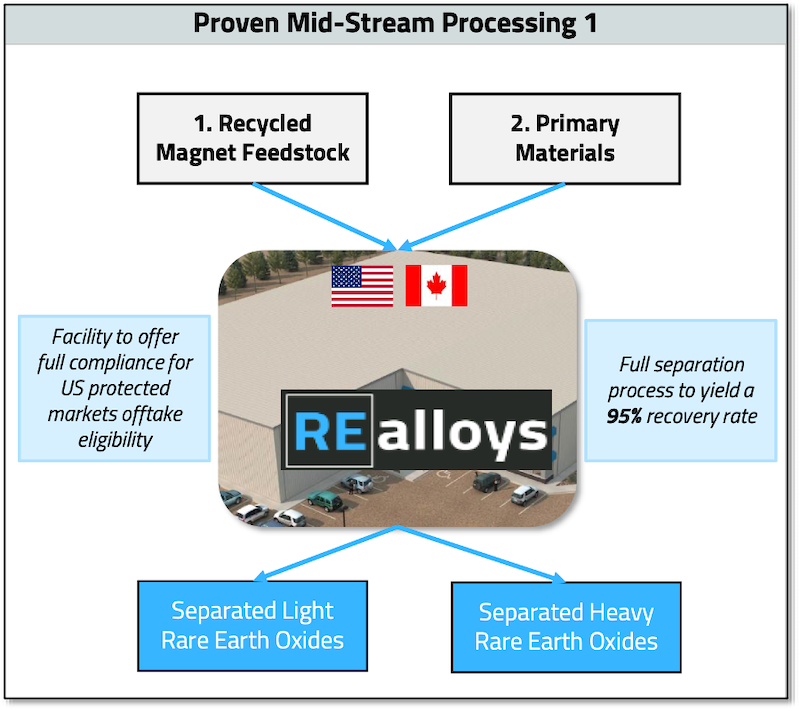 |
| REalloys will take not only newly mined materials, but also recycled feedstock for its U.S.-based processing facilities.
|
| Building The Mine-to-Magnet Supply Chain
|
| Rather than focusing only on mining, REalloys is building a vertically integrated platform spanning the entire rare earth value chain.
The company’s strategy connects:
|
| • upstream rare earth resources
• midstream separation and metallization
• downstream magnet materials and alloy manufacturing
|
| That integrated approach is designed to rebuild the North American rare earth processing ecosystem.
REalloys’ upstream foundation includes the Hoidas Lake rare earth project in Saskatchewan, a heavy-rare-earth-rich deposit where more than $40 million has already been invested.
|
| Heavy rare earths such as dysprosium and terbium are particularly important because they enable magnets to function in high-temperature and extreme environments like fighter jets, missile systems and advanced motors.
|
| But the company isn’t relying on a single resource.
REalloys has also secured diversified feedstock through partnerships with multiple mining and recycling sources, ensuring a steady pipeline of rare earth materials. Those materials are then processed through the company’s developing metallization and magnet manufacturing platform in Euclid, Ohio.
That facility is intended to convert rare earth feedstock into high-purity metals, alloys and magnet components for defense, clean-energy and industrial markets.
And the company recently received a major validation of that strategy.
|
| An Historic U.S. Defense Contract
|
| On March 2, REalloys announced that the U.S. Defense Logistics Agency awarded a contract to its subsidiary, Terves LLC, to scale domestic production of samarium and gadolinium metals.
Those two metals play critical roles in some of the most demanding defense technologies.
|
| Samarium-cobalt magnets can withstand extremely high temperatures and are used in fighter jet engines, missile guidance systems and aerospace equipment.
Gadolinium is used in radar systems, advanced optics and nuclear reactor safety components.
|
| Today, the United States relies almost entirely on overseas suppliers for these materials.
And that’s where the Defense Logistics Agency comes in: It manages the supply chain for the Department of Defense, NASA and other federal agencies. Through its Strategic Materials division, the agency also oversees the National Defense Stockpile and is tasked with securing domestic sources of critical materials.
The contract awarded to REalloys is designed to scale next-generation metallothermal processing for samarium and gadolinium metals.
|
| In practical terms, that means helping establish domestic production capabilities that currently do not exist in the United States.
|
| And the company believes its proprietary technology may provide a new way to achieve that goal.
|
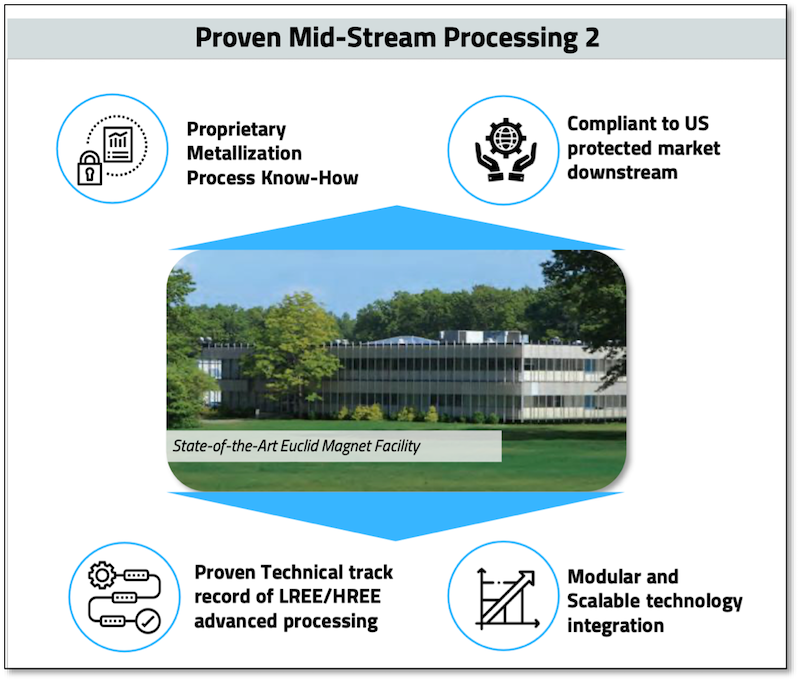 |
| A true one-stop-shop for U.S. rare earth independence, REalloys will utilize its proprietary metallization processing on rare earth feedstock, even through the production of magnets.
|
| A New Approach To Rare Earth Processing
|
| Traditional rare earth processing relies on massive solvent extraction plants that are expensive to build and difficult to scale.
|
| In contrast, REalloys is developing a modular metallization system designed to reduce rare earth feedstocks directly into high-purity metals.
|
| The process is built around semi-continuous reactors and a zero-waste metallization platform that recycles process byproducts. According to the company, this approach could reduce capital requirements, cut operating costs and shorten deployment timelines compared to conventional facilities.
The Defense Logistics Agency contract includes engineering work for a modular, 300-ton-per-year production facility capable of producing samarium and gadolinium metals. That modular design could allow the company to replicate facilities and scale production more quickly as demand grows.
And demand is expected to grow dramatically.
|
| The Magnet Market Is Expanding Rapidly
|
| Permanent magnets built from rare earth metals are the hidden workhorses of modern industry.
|
| They power electric motors, robotics systems, precision weapons, aerospace equipment and renewable energy infrastructure.
|
| The strongest and most widely used of these are neodymium-iron-boron magnets, commonly known as NdFeB magnets.
Their exceptional strength-to-weight ratio allows compact motors to produce extremely high power output.
That capability is essential for everything from electric vehicles to industrial automation.
Analysts project that the global NdFeB magnet market could grow from roughly $32 billion today to more than $59 billion over the next decade.
|
| Defense modernization, electrification and advanced robotics are all major drivers. And companies that control the materials used to produce those magnets could occupy a powerful position in the industrial supply chain.
|
| REalloys intends to participate directly in that market by producing both rare earth metals and magnet components from its Ohio manufacturing platform.
|
| New Capital To Accelerate Growth
|
| To support its development plans, REalloys recently strengthened its balance sheet with an upsized $50 million public offering of common stock.
|
| The financing provides additional capital for working capital and general corporate purposes as the company continues building out its rare earth processing and manufacturing platform.
|
| For investors, that financing signals that the company is now moving into the next stage of its development — from technology development to industrial deployment.
|
| A Leadership Team Built for the Mission
|
| Building a domestic rare earth supply chain requires expertise across defense, manufacturing and government policy.
REalloys has assembled a leadership team that reflects that challenge.
|
| Chairman Stephen DuMont previously served as president of GM Defense and held senior roles at Raytheon, Boeing and BAE Systems.
The company’s board also includes General Jack Keane, a former four-star U.S. Army general and vice chief of staff.
Other directors include David MacNaughton, former Canadian ambassador to the United States and current president of Palantir Canada, and Brad Wall, the former premier of Saskatchewan.
|
| Together the group brings experience in defense procurement, resource development and international policy.
Exactly the areas required to rebuild critical industrial supply chains.
|
| Why Investors Are Watching Now
|
| Rare earth elements are increasingly recognized as strategic materials.
Governments across North America and Europe are pushing to secure domestic supply chains for the components that power advanced defense systems and next-generation manufacturing.
|
| Companies capable of building that infrastructure could find themselves operating in a powerful policy tailwind.
And REalloys believes its integrated mine-to-magnet model positions it to play a central role in that transition.
|
| If the company succeeds in scaling its processing and metallization technology, it could help close one of the most critical gaps in the Western rare earth supply chain...and potentially capture significant value in the process.
Which brings us back to Rockefeller.
|
| The companies that shaped the last century of industrial growth were the ones that controlled the processing infrastructure.
|
| Not just the raw resources.
If rare earths truly are the “digital gunpowder” of the modern economy, then the companies building the refineries of that system may be the ones to watch.
And REalloys is positioning itself to become one of them.
|
| CLICK HERE
To Learn More About REalloys (ALOY.Nasdaq)
|


.png)


