|
| There is an ingredient nobody in the battery industry talks about.
|
| You hear about lithium constantly. An entire investment ecosystem built around the “L” in LFP (Lithium-Iron-Phosphate) batteries.
But lithium is only 4% of the LFP battery cathode by mass.
Phosphate is 60%.
Obviously, phosphate is the dominant material in an LFP battery cathode, and by a wide margin. So here’s the problem, and the opportunity:
|
| The mineral everyone is racing to control is, in terms of actual battery chemistry, almost incidental…the lithium.
...And the one that makes up the majority of every single cathode is the one where western supply chains are most vulnerable…the phosphate.
|
| Enter First Phosphate Corp. (PHOS.CSE; FRSPF.OTC) — building a fully integrated, mine-to-market LFP battery supply chain for North America, starting from the ground up with precisely the right kind of rock.
|
| The Critical Supply Chain Nobody Is Talking About
|
| LFP batteries have quietly become the dominant global battery chemistry.
|
| Estimates put them at 60% to as much as 80% of all batteries currently produced on Earth, and the trend is accelerating.
|
| They are cheaper, safer and more versatile than any alternative. And they don’t just power electric vehicles.
|
| Grid-scale energy storage, AI data centers, robotics, defense systems and telecom infrastructure are all markets for these batteries.
And demand across every one of those sectors is growing…fast.
|
| This is why purified phosphoric acid (PPA) — the battery-grade form of phosphate — ranks among one of the most important minerals for the global energy transition.
Western supply, meanwhile, is essentially flat, with no realistic path to expansion through conventional sedimentary phosphate processing.
The gap between what the world needs and what the West can produce is widening by the year. And that’s not the only issue....
|
| Not All Phosphate Is Created Equal
|
| Sedimentary phosphate, which is mined in places like Morocco, China and the southeastern United States, is contaminated with cadmium, uranium and thorium.
Most of it cannot be easily and economically upgraded to battery-grade PPA and is therefore primarily used in fertilizer, creating radioactive gypsum waste piles in the process.
Igneous phosphate is different.
|
| Formed from volcanic rock rather than ocean sediments, it is essentially free from radioactive contaminants.
|
| Best of all: Over 90% of it can be converted directly into purified phosphoric acid for LFP batteries, with smaller waste streams containing a clean, recyclable gypsum byproduct.
|
| However, igneous phosphate represents only about 5% of global production.
|
| It exists in just a handful of places: northern Russia (now sanctioned), southern Africa (difficult geography), Brazil (mostly diverted to fertilizer) and a few small regions in Canada.
|
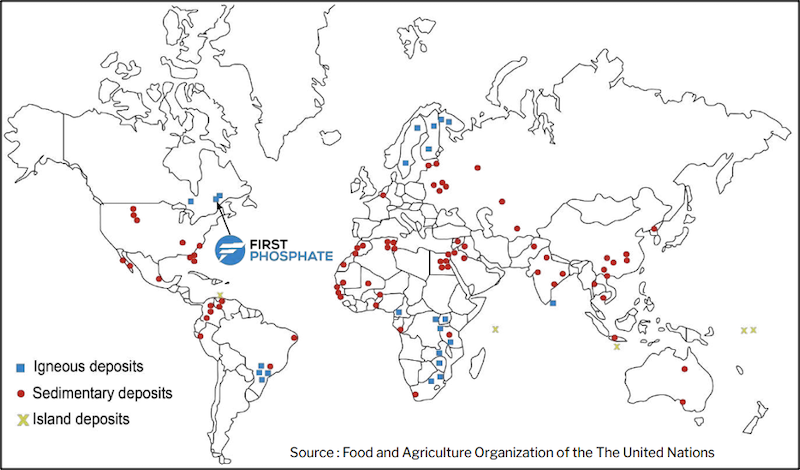 |
| Igneous anorthosite deposits of phosphate are far and few between, and First Phosphate controls one of the only ones located in North America.
|
| That’s where First Phosphate (PHOS.CSE; FRSPF.OTC) has been quietly building what may be the most strategically important junior mining high-purity phosphate project in North America....
|
| The Best Of The Best?
The Bégin-Lamarche Property
|
| So if igneous phosphate is the best for batteries, and if Canada is the best jurisdiction for these deposits...what’s the best deposit?
|
| It’s easy to see why many believe that First Phosphate’s Bégin-Lamarche property gets the prize.
|
| For one thing, it sits in Saguenay–Lac-Saint-Jean, Quebec, a region with established heavy industry, abundant hydroelectric power and direct rail and deep-water port access.
|
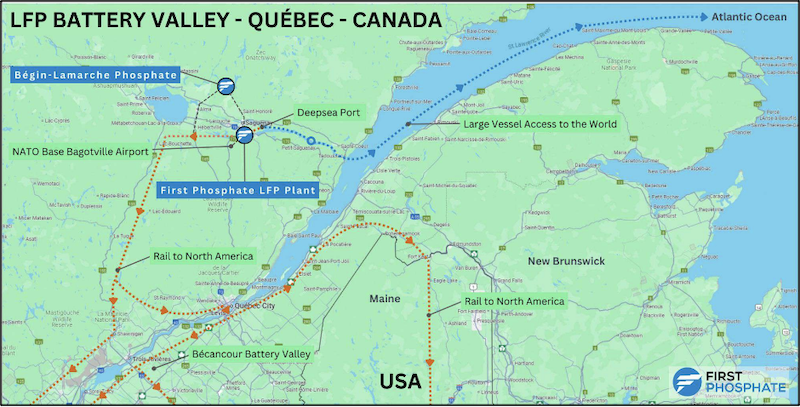 |
| First Phosphate’s Bégin-Lamarche property is well located for ease of transport and LFP production.
|
| The deposit is 2.5 kilometers long, 300 meters wide and still open at depth.
The preliminary economic assessment paints a compelling picture:
|
- A C$2.1 billion net present value at an 8% discount rate
- A 37.1% internal rate of return
- A relatively short 2.9-year payback period
- And a long 23-plus-year mine life
|
| Targeted production, at approximately 900,000 tonnes per year of concentrate, will move the needle in terms of required high purity phosphate for the North American energy transition.
And the rock is exceptional.
Consider that First Phosphate’s concentrate consistently grades above 40.9% P₂O₅, among the highest igneous phosphate grades globally.
This outperforms deposits in Russia, South Africa, Finland, Brazil and Morocco.
|
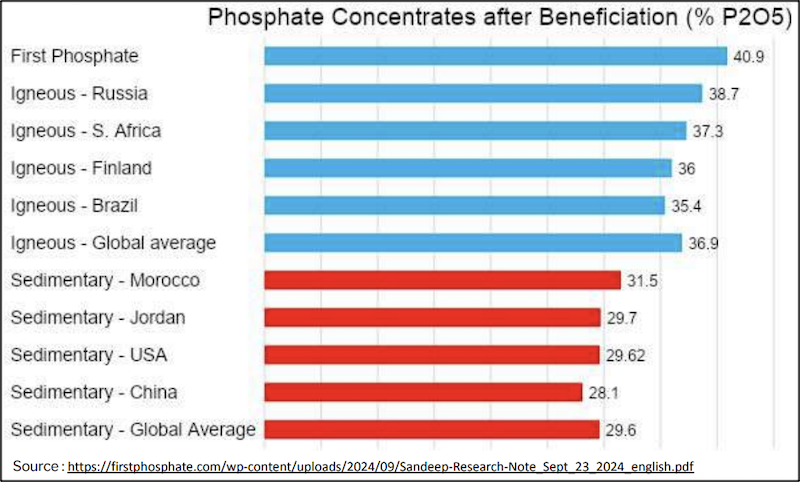 |
| First Phosphate’s P2O5 concentrate ranks higher than the averages from other igneous and sedimentary phosphate sources.
|
| A recently completed infill drilling program across First Phosphate’s property confirmed continuous, high-grade mineralization across all three resource zones and uncovered two newly discovered phosphate intersects.
And an updated geological model is expected shortly.
|
| A Mine-To-Market Story Nobody Else Can Tell
|
| Now here’s where it gets even more interesting and important....
First Phosphate (PHOS.CSE; FRSPF.OTC) is also building a fully integrated, mine-to-market LFP battery supply chain entirely within North America.
|
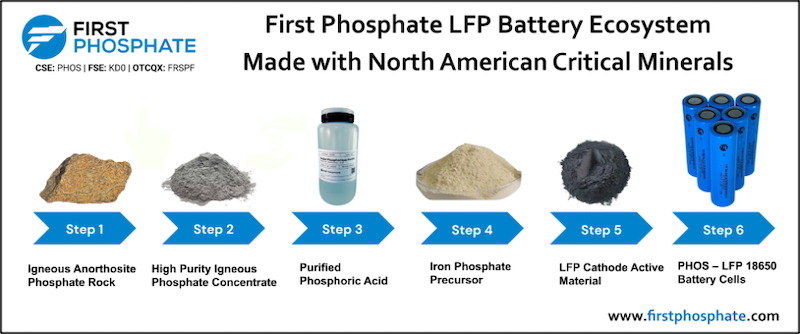 |
| Working with some of the largest names in the global battery and materials industries, the company has taken its igneous phosphate rock all the way through to finished LFP battery cells.
|
| The result: the first LFP battery cells manufactured using North American critical minerals, successfully cycled 2,000 times at fully commercial performance rates.
|
| Every step is a commercial process ready to scale.
The phosphoric acid plant is planned for the deep-sea Port of Saguenay, approximately 70 kilometers driving distance from the mine, with rail and ocean access for deliveries to North American and European customers.
Definitive offtake agreements are already in place, with announced offtake-related pre-payment already committed.
|
| Sovereigns Coming To The Table
|
| When a project is nationally strategic, governments put real money behind it.
In March 2026, the Government of Canada finalized a $16.7 million non-repayable contribution to First Phosphate (PHOS.CSE; FRSPF.OTC) through Natural Resources Canada’s Global Partnerships Initiative.
|
| To be clear: This is a direct government investment into the Bégin-Lamarche feasibility study and processing development through 2028.
|
| Canada’s Minister of Energy and Natural Resources personally endorsed the project.
In April 2026, Denmark’s state-backed export credit agency, EIFO, issued a letter of intent for a guarantee of up to EUR 170 million in equipment and services for the project.
The U.S. Export-Import Bank is also at the table.
And Canada’s 30% refundable clean technology input tax credit now applies to all phosphate processing capital, significantly strengthening the project’s economics.
That is a capital stack being assembled by sovereigns, not speculators.
|
| Big Gold Noticed First
|
| On May 4, 2026, Agnico Eagle Mines, the world’s second-largest gold producer, moved through its subsidiary to acquire Fox River Resources.
|
| The all-cash transaction came in at roughly C$94 million, a 20% premium to market. Fox River’s sole asset: the Martison Phosphate Project in Ontario, one of just three igneous phosphate projects in all of North America.
|
| When the world’s second-largest gold miner writes a $94 million check for phosphate, something important is happening in this sector.
That acquisition left just two independent igneous phosphate companies on the continent, with First Phosphate (PHOS.CSE; FRSPF.OTC) having the single focus on the LFP battery market.
|
| Plus:
The CEO Is Buying Right Alongside You
|
| CEO John Passalacqua has purchased nearly 2,872,000 shares in the open market since May 2023. Personal capital, at market prices, alongside retail investors.
He is compensated 100% in equity. The board is paid 100% in equity. Management takes 50% cash, 50% stock.
|
| The company has raised approximately $62.5 million since inception through 10 management-led, non-brokered private placements.
|
| Management and the board hold approximately 20% of the company.
There are 179.9 million shares outstanding, zero debt and more than $20 million in treasury. The warrant overhang has been cleaned up, with only 2.625 million warrants remaining, all held by current staff, management and board.
This is a tight, clean, owner-operated structure.
|
| Get Ready For What Comes Next...
|
| In terms of catalysts to potentially launch market re-ratings, the pipeline is full:
|
| • A fully funded feasibility study is targeted for completion by end of 2026. Permitting follows in 2027, construction in 2028 and first production is targeted for 2029.
• An updated geological model is expected imminently. Offtake agreements continue to develop.
• And the sector re-rating triggered by a major gold company’s move into phosphate is only beginning.
|
| The world needs battery-grade phosphate.
The opportunity is this: First Phosphate (PHOS.CSE; FRSPF.OTC) is sitting on arguably the most advanced, highest-grade, best-located igneous phosphate project remaining in North America, with a proven supply chain, government capital behind it and a CEO who put his own money in first.
The phosphate that the battery revolution runs on has to come from somewhere. And First Phosphate (PHOS.CSE; FRSPF.OTC) is in a prime position to supply it.
|
| CLICK HERE
To Learn More About First Phosphate
|


.png)


