| Gold is down today, as the latest peace deal seems to prove fleeting once again.
|
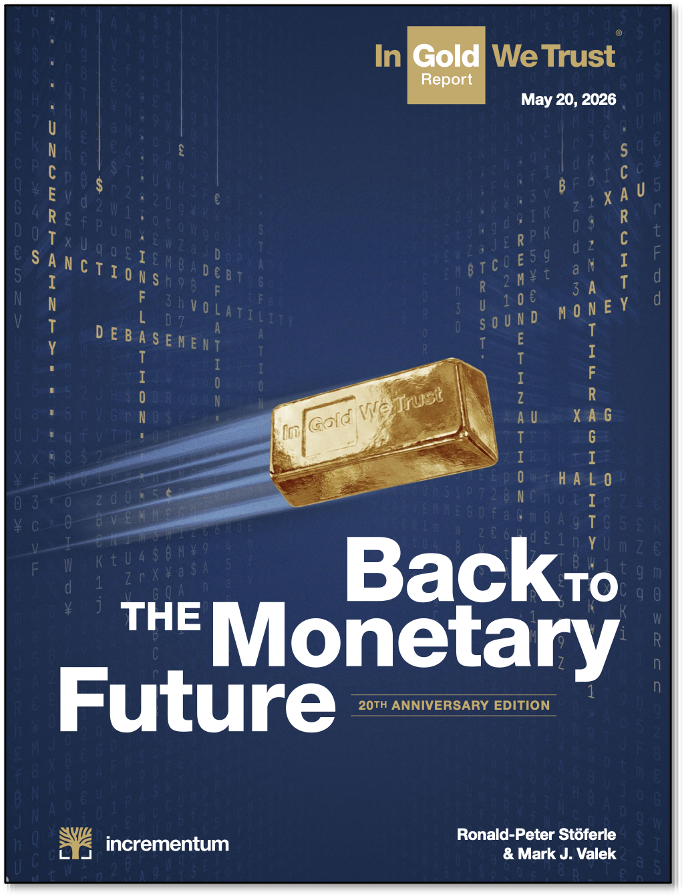
| This is completely irrelevant for gold’s longer-term prospects. And if you aren’t already convinced of that, you need to read the latest edition of the renowned In Gold We Trust report.
|
| As I’ve said before, this is simply the single best annual analysis of the gold market produced anywhere in the world.
|
| And, remarkably, our friends Ronald-Peter Stoeferle, Mark Valek and their team continue to distribute this monumental work entirely free of charge.
|
| This year’s edition — appropriately titled “Back to the Monetary Future” — may be the most ambitious and important version yet. Spanning roughly 460 pages, it compiles two decades of research and market analysis into what the Wall Street Journal once called “the gold standard of all gold studies.”
|
| And this year’s themes strike directly at the heart of what I’ve been discussing in this newsletter.
|
| The report makes a compelling case that gold is gradually being remonetized as a neutral reserve asset within an increasingly fragmented global monetary system. In other words, central banks are buying gold because confidence in the existing monetary order is eroding.
The study also explores one of the more fascinating emerging developments in the sector: the growing role of Tether and tokenization in the gold market.
And perhaps most notably, their proprietary gold model reached its original conservative $4,800 target years ahead of schedule. The focus now shifts toward a far more inflationary scenario that projects gold potentially reaching $8,900 by decade’s end, along with even longer-term projections extending out to 2045.
The report also does an excellent job highlighting why silver, commodities and mining equities have begun to follow gold’s leadership after many months of lagging behind. And its discussion of the “new 60/40 portfolio” — where gold, commodities, miners and even Bitcoin increasingly compete for strategic allocation status — is particularly timely given the obvious strains within traditional portfolio construction.
|
| One especially interesting chart from this year’s edition examines gold’s seasonality since 1970. January historically delivers the strongest average monthly returns, while September and November have proven the most reliable months overall. Meanwhile, March and June tend to disappoint more often than not — which is obviously a timely observation.
|
| And, as always, the report is packed with dozens upon dozens of superb charts, historical comparisons and macroeconomic insights that will help you better understand not just where gold has been...but where this market may still be headed.
As usual, it’s an extraordinary piece of work — and one every serious gold investor should read.
I strongly encourage you to download it by clicking here.
|
| Brien Lundin
Publisher, Gold Newsletter
CEO, the New Orleans Investment Conference
|


.png)