|
| Gold exploration is full of interrupted stories — projects that got taken all the way to the finish line, then stopped for reasons that had nothing to do with the gold in the ground.
|
| That’s exactly what happened at Xali Gold’s (XGC.V; CGDXF.OTC) Pico Machay project, a gold deposit in the Peruvian Andes that was on the fast track toward production.
|
| As you’re about to see, why that project was stopped...and why it represents such an extraordinary opportunity today...is a fascinating and potentially very profitable story.
|
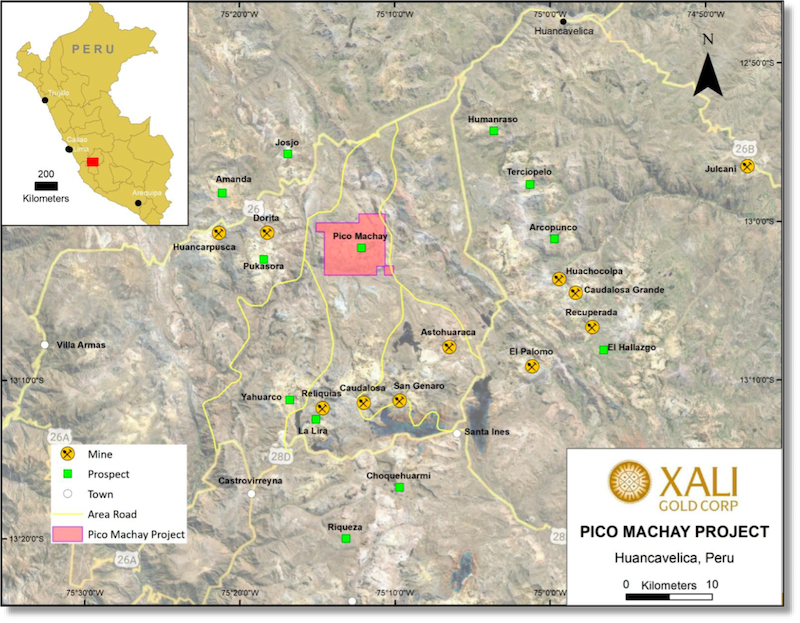 |
| Click image to enlarge
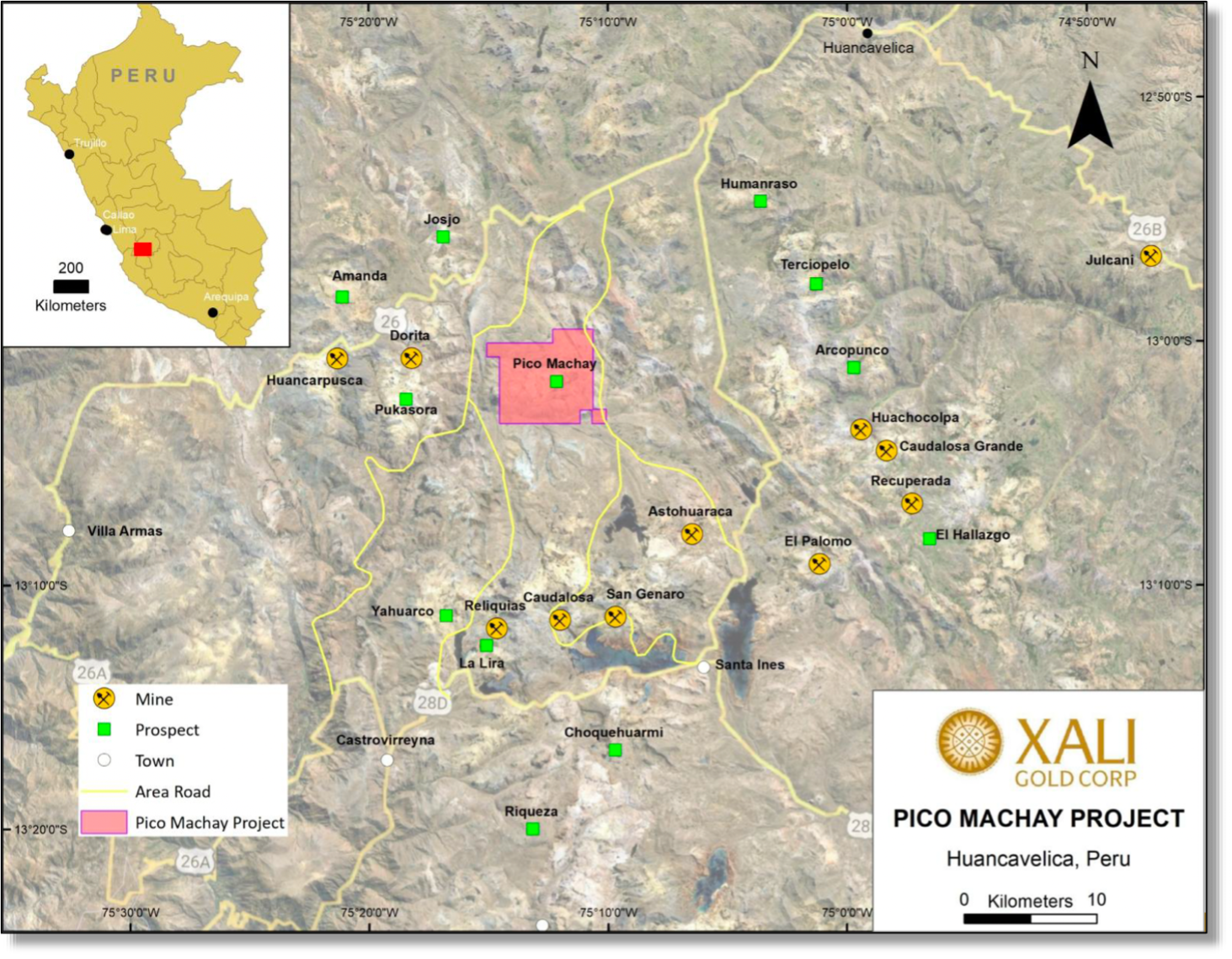
Xali’s Pico Machay project is surrounded by a number of other mines and exploration prospects in a mining-friendly region of Peru.
|
| Previous owners, including Aquiline Resources, drilled this deposit for over a decade. Aquiline completed resource estimates, metallurgical test work, engineering studies and a full feasibility study.
|
| In 2009, with gold at just $700 an ounce, Aquiline viewed the projected economics as rich enough to begin construction of a mine.
|
| Then, before they could start the process, Aquiline was purchased by a larger company...and Pico Machay sat untouched for 15 years while gold climbed from $700 to where it trades today.
Xali Gold just woke it up.
|
| A Multi-Year Head Start
|
| So when Xali Gold acquired Pico Machay in December 2025, they weren’t starting from scratch.
|
| In fact, they were inheriting years of drilling data, engineering studies and completed environmental work that most junior companies spend a decade and millions of dollars building.
|
| The heap leach pad sites had already gone through condemnation drilling. Aquiline had completed approximately 50% of the detailed Environmental Impact Assessment required for operations.
All this represents a huge head start — and translates directly into time saved on the path to production.
|
| (And as you’re about to see, it has an even more profound implication on the project’s profitability today.)
|
| The historical resource — all 154 drill holes, delineated in a single central zone — reflects a Historical Measured and Indicated Resource of 264,600 ounces of gold (10.6 million tonnes grading 0.78 g/t gold) and a Historical Inferred Resource of 446,000 ounces of gold (23.9 million tonnes grading 0.58 g/t gold).
And this looks to be merely the start: Nine additional high-potential exploration targets on the property have never been drilled.
|
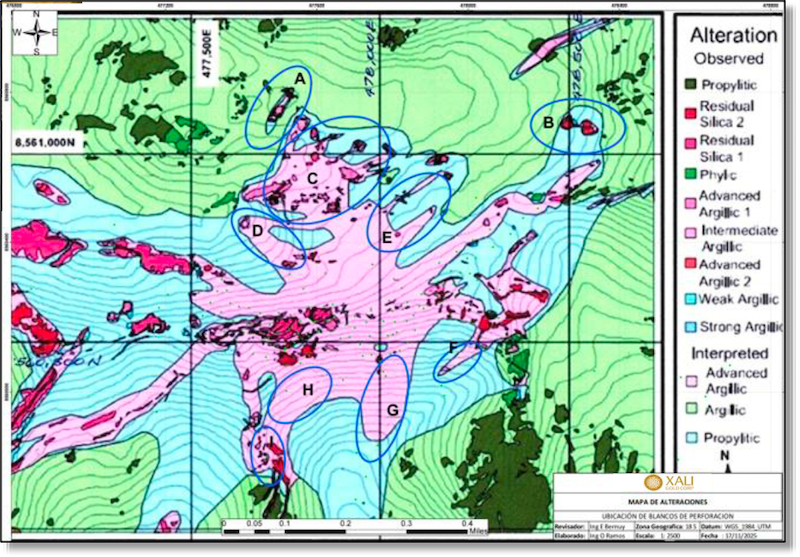 |
| In addition to the already impressive resource explored by prior owners, Xali Gold has nine other identified areas it is targeting for exploration.
|
| Now consider this: That historical resource was established at a gold price of just $700/ounce. With gold trading over $4,000 today, the economics of what is already known look dramatically different — and the upside from nine untested targets is still entirely in front of the company.
|
| And here is another key point: Confirming this historical resource does not require a massive drilling campaign.
|
| Only approximately 10% of the original holes need to be twinned with new diamond core drilling (only about 1,500 meters in total) to update the historical estimate to a current, NI 43-101 compliant resource.
Xali Gold has budgeted 3,000 meters for the upcoming program, meaning the second half of that drilling budget goes directly toward potential resource expansion.
|
| The confirmation work, in other words, comes at a very low cost relative to the massive prize on the other side of it: A sizeable gold project with robust economics and a head start on development.
|
| Here is what makes the entry point equally compelling: Xali Gold acquired 100% of Pico Machay for just US$15.0 million in staged payments spread over five years. At current resources, that works out to just over $20 per ounce of gold in the ground.
If they delineate a total of 1.25 million ounces — a milestone the team believes is very achievable given what is already known — Xali Gold would pay an additional US$2.5 million and the effective acquisition cost drops to approximately $14 per ounce.
At a gold price more than six times higher than the one that justified the original production decision, the math writes itself.
|
| The Grade Upgrade
|
| There is another layer to this story that deserves particular attention.
Every one of the 154 holes that defined the historical resource at Pico Machay was drilled by reverse circulation. RC drilling is efficient, but it produces small chips of rock rather than continuous core.
And at Pico Machay, fine gold and free gold are known to be present in the system. When those RC chips were flushed from the drill holes, some portion of that fine gold may have washed away with them.
|
| The historical resource grades, in other words, may significantly understate what is actually in the ground.
|
| The upcoming program will use diamond core drilling. This core drilling captures intact, continuous rock — nothing washes out.
So it’s easy to see why the Xali Gold team believes the grades from the upcoming diamond drilling could prove meaningfully higher than what the historical resource reflects.
|
| That is a potential grade upgrade layered on top of the resource confirmation…which is itself being pursued alongside nine untested exploration targets that have never seen a drill bit.
|
| Three separate potential value drivers — grade upgrade, resource confirmation and resource expansion — all being advanced in a single drilling campaign. On a project where a production decision was already made when the gold price was a small fraction of today’s lofty levels.
|
| Dormant To Drill-Ready In A Relative Flash
|
| What has followed the acquisition of Pico Machay is a textbook case of hitting the ground running.
|
| Within weeks of closing, the team was on the ground in Peru, beginning engagement with the local Santa Ana community and initiating the systematic relogging of approximately 20,000 meters of historical RC drill cuttings.
|
| The geological model reconstruction immediately followed in February and, on February 22nd, the community of Santa Ana formally authorized Xali Gold to advance exploration activities at Pico Machay.
By spring, the geological and technical team had completed Phase I of the historical drill core relogging, initiated underground and surface rock chip sampling with samples submitted for gold, silver, and multi-element analyses, and assembled an experienced Peruvian engineering team to support the updated feasibility work.
Environmental baseline studies for the drilling permit application were completed in May. The drilling permit is expected to be received in June. Drilling is expected to begin as soon as July.
|
| Just over six months from closing to drill bit. That is a lightning-fast pace Xali Gold is setting right now.
|
| An updated NI 43-101 compliant resource estimate is targeted for the third quarter of this year.
The Preliminary Economic Assessment will follow — and that’s when the market will see, for the first time in 15 years, what the projected value of Pico Machay is near today’s sky-high gold prices.
|
| Still Under The Radar
|
| Why hasn’t the market figured this out?
What Aquiline spent years and tens of millions of dollars to prove at Pico Machay is now in Xali Gold’s hands — at a gold price more than six times higher than the one that justified the original production decision.
The updated resource estimate and PEA, expected later this year, will quantify for the first time what that combination actually means in economic terms.
|
| And it’s very likely that the net present value of Pico Machay will far, far exceed Xali Gold’s current market value.
|
| That is not a distant event. It is close. And for investors who understand the value of what has already been proven here, the case for looking at Xali Gold now — before those numbers are on the table — is straightforward.
|
| CLICK HERE
To Learn More About Xali Gold Corp.
|


.png)