|
| Nine weeks ago, we introduced you to one of the more compelling setups in the junior resource space.
|
| The story centered on a multi-million-ounce gold-copper porphyry in Ecuador’s Zamora belt, built by the same team that founded Silvercorp Metals and trading at a dramatic discount to peers.
Since that report, two things have changed.
|
| First, the company formally changed its name from Tincorp Metals to Auro Metals (AURO.V; AURFF.OTC), reflecting its new focus on the Santa Barbara Gold-Copper project. The ticker has changed. The story — and the team behind it — has not.
Second, and far more significantly: the drills have delivered.
|
| As of July 14, Auro has reported the first six assay results from its Phase 1 drill program.
They were, by any measure, blockbuster numbers. And with many additional assay batches still pending from a four-rig program, the information flow is just getting started.
|
| What The Drills Just Confirmed
|
| The numbers speak for themselves.
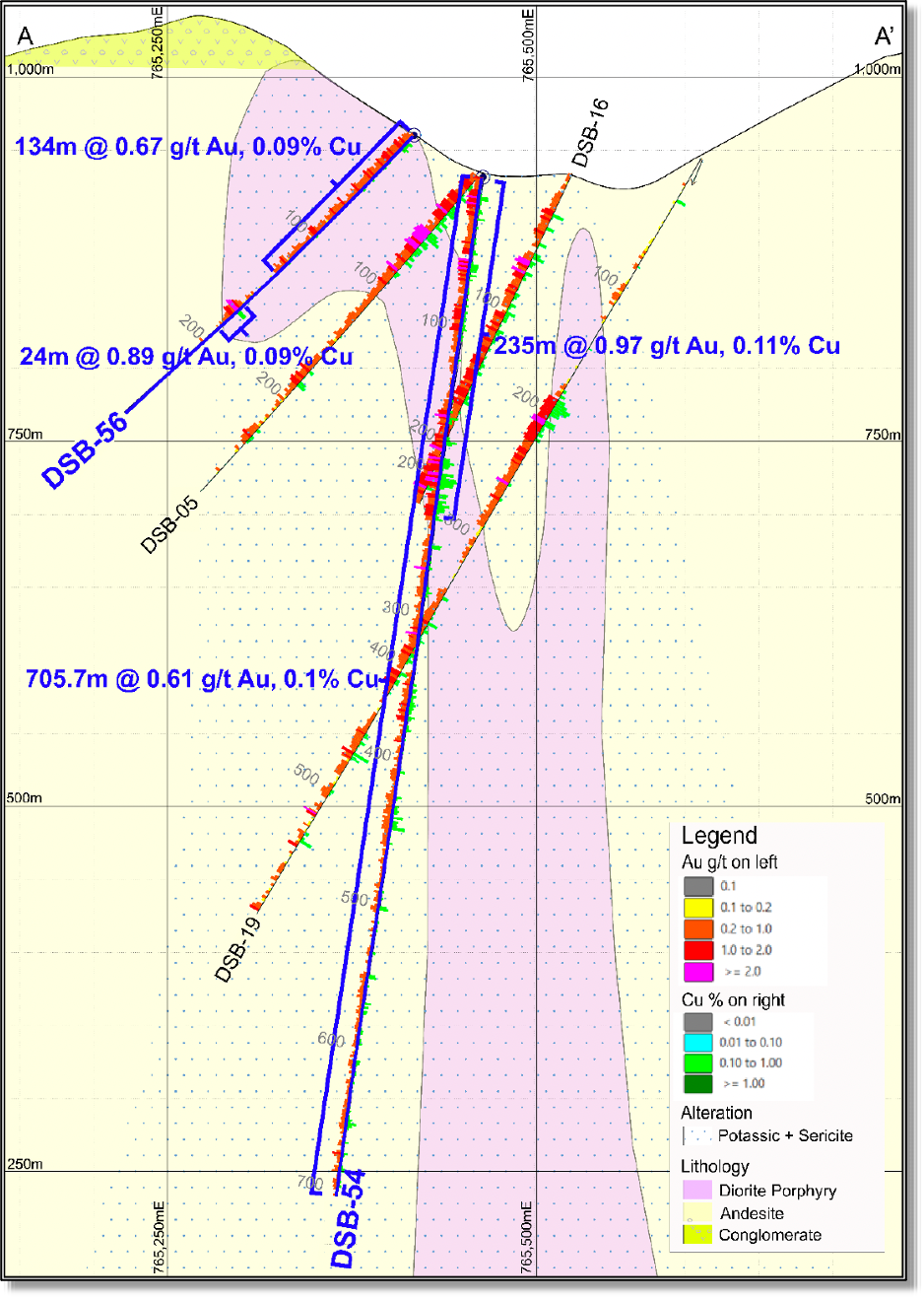
Drillhole DSB-54 intersected an extraordinary 705.7 meters grading 0.61 g/t gold and 0.10% copper — from surface — including a higher-grade interval of 235 meters grading 0.97 g/t gold from surface.
|
| The hole was fully mineralized and ended in mineralization at depth, meaning the system continues beyond where the drill stopped.
|
| For a porphyry system, 705.7 meters of continuous gold-copper mineralization starting at the very surface — with the hole ending in ore — speaks to a scale that is genuinely unusual at this stage of a project’s development.
Hole DSB-59 reinforced the picture to the southeast. The hole intersected 625.1 meters grading 0.64 g/t gold and 0.1% copper from 81 meters, ending in mineralization.
The four other holes also delivered good intersections, including:
DSB-55 – 246 meters grading 0.56 g/t gold and 0.09% copper from surface, including 155.5 meters at 0.73 g/t gold and 0.11% copper from 31 meters.
DSB-56 – 134 meters grading 0.67 g/t gold and 0.09% copper from surface, and a second interval of 24 meters at 0.89 g/t gold from 164 meters.
DSB-57 – 59 meters grading 0.67 g/t gold and 0.1% copper from surface, and a second interval of 37.5 meters grading 0.5 g/t gold 0.1% copper from 92 meters.
DSB-58 – 130 meters grading 0.6 g/t gold and 0.1% copper from 81 meters.
|
 |
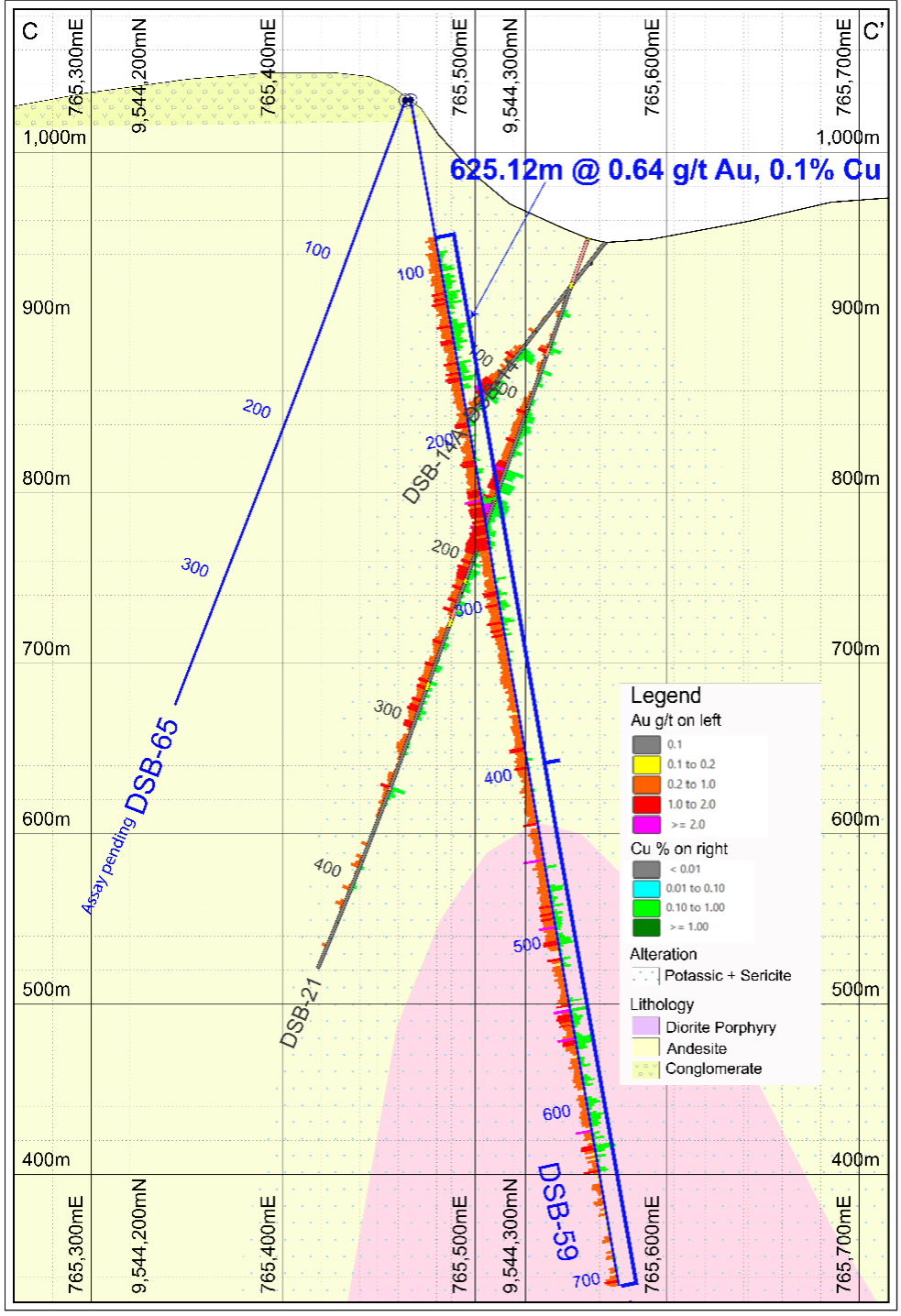 |
| Auro’s recent drill result releases show exceptionally long intersections of continuous gold-copper mineralization, starting at surface.
|
| Most holes started in mineralization at the collar.
|
| Drilling confirmed that the system remains open in the up-dip direction toward surface — meaning there is likely additional mineralization shallower than any of these holes yet tested.
|
| The consistency of grade across these holes drilled to test continuity between historical intercepts is precisely what Phase 1 was designed to demonstrate – and it delivered.
|
| Santa Barbara: Scale That Demands Attention
|
| For readers encountering this story for the first time, here is the context.
Santa Barbara sits in the Zamora Copper-Gold Belt in southeastern Ecuador — the same neighborhood as massive projects such as Lundin Gold’s Fruta del Norte mine, the Mirador copper-gold mine and Solaris Resources’ Warintza deposit.
|
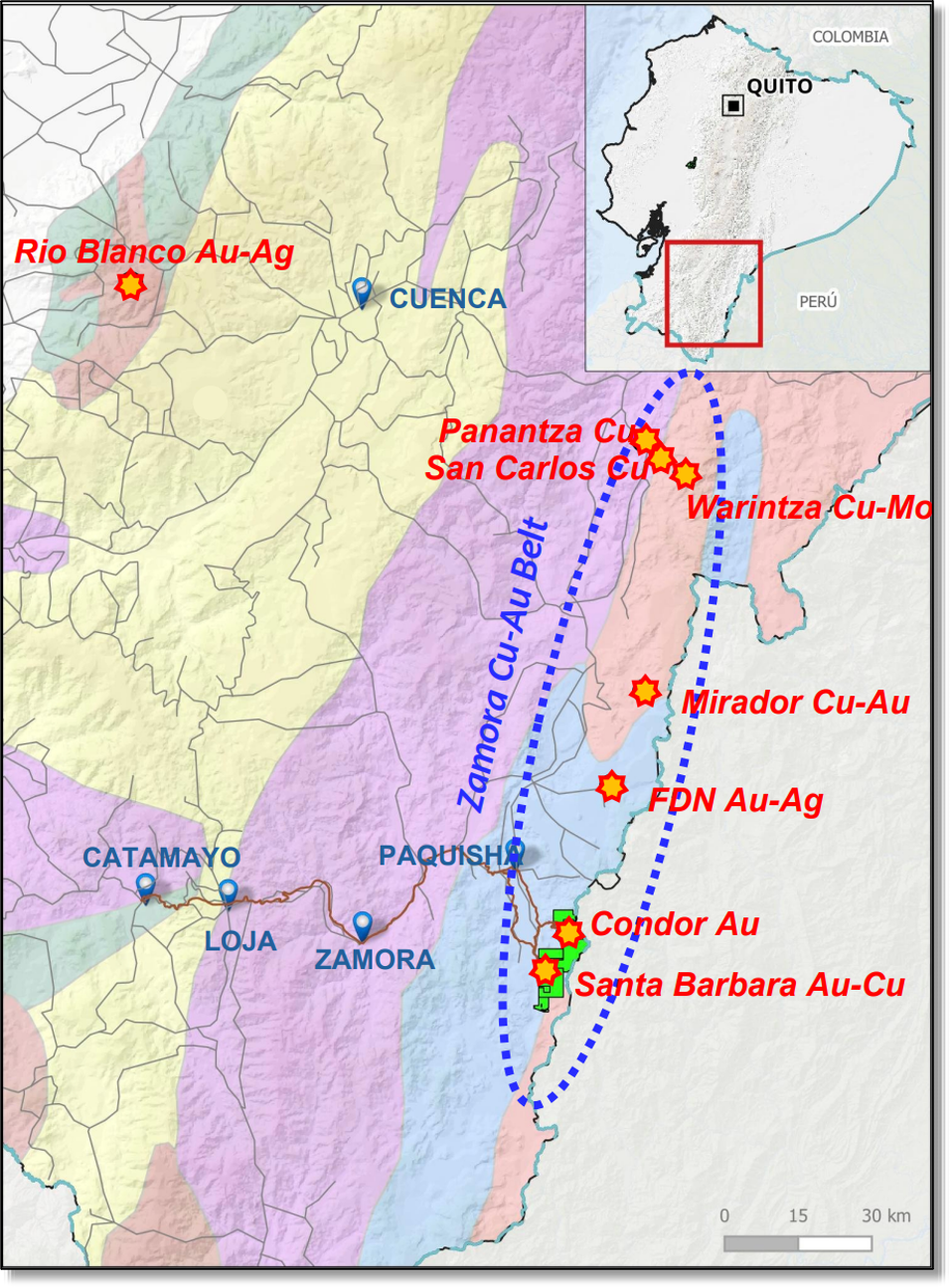 |
| Auro’s Santa Barbara project is located in the renowned Zamora Copper-Gold Belt and surrounded by numerous world-class mines and projects.
|
| Over the past year or so, that belt has seen about $1.5 billion in M&A activity, with major acquirers targeting precisely the kind of large-scale, technically credible copper-gold porphyry that Auro controls.
|
| The remaining inventory of such assets is finite — and Santa Barbara is one of them.
|
| It is a large-scale, gold-copper porphyry system with an existing NI 43-101 resource of 697,000 ounces of indicated gold at 0.73 g/t and 3.42 million ounces of inferred gold at 0.52 g/t.
Combined with copper, the total gold-equivalent resource is approximately 4.3 million ounces — and that’s all before the recent and upcoming drill results have been incorporated.
That resource was built on just 56 holes over three decades of intermittent work, with no drilling at all since 2018. The deposit is open in every direction.
Phase 1 — a 10,000-meter infill program — is designed to convert inferred ounces to indicated and lay the technical foundation for a future resource update. Based on the first six holes, that program is off to a very strong start.
|
| And Still More Drill Results To Come
|
| So far, 16 Phase 1 holes have been completed, and only six have been reported.
Ten remain outstanding, with assays being released as they come in.
|
| Each one is a separate news release and a potential catalyst.
|
| After Phase 1 wraps, Phase 2 steps out to extend the resource envelope — expanding laterally and at depth. Phase 3 tests exploration targets across the broader 55.3-square-kilometer land package outside the current resource envelope entirely, with the potential to reveal a second mineralized center.
The company has all three phases of drilling completely funded and ready to execute sequentially.
In other words, Auro is not running out of news flow anytime soon.
|
| The Team That Can Take This All The Way
|
| None of this would carry the same weight without the right team in place.
Auro is built by the same individuals who founded and grew Silvercorp Metals from a grassroots explorer into one of Canada’s most consistently profitable silver-gold producers — a company that went from junior to multi-mine producer generating consistent free cash flow and dividend payments.
|
| That is a full cycle: exploration to discovery to resource definition to production. The Auro team has done it before, and they are applying that same institutional playbook here.
|
| Dr. Rui Feng, founder of Silvercorp and New Pacific Metals, is the architect of this enterprise. CEO Victor Feng and technical director and Qualified Person Alex Zhang — both Silvercorp alumni — are executing on the ground in Ecuador.
This is the same institutional apparatus that built Silvercorp, now applied to a large-scale porphyry system with a defined multi-million-ounce resource, active drill rigs on site and incoming results that signal more to come.
|
| The Opportunity Right Now...
|
| The drill results from DSB-54 and DSB-59 are the kind of intercepts that force eyes onto a story. Here is what investors are looking at:
|
- 600-700+ meters of continuous gold-copper mineralization from or near surface, ending in mineralization at depth
- A system open at depth, at surface and along strike in multiple directions
- Nine more assay batches pending from the current four-rig program
- A fully funded three-phase drill program stretching into 2027
- A Silvercorp-pedigree team that has taken a junior company all the way through to producing mine
|
| And all of this is on top of a massive, 4.3-million-ounce gold-equivalent resource.
Simply put, Auro’s current market cap does not yet reflect the immense scale of what’s in the ground — or the potential of what the next nine assay batches and next two drilling phases may reveal.
The incoming news flow is poised to change that.
|
| CLICK HERE
To Learn More About Auro Metals
|


.png)


