|
| It is easy to miss what is right in front of you when you have only ever seen part of it.
|
| The Tuscarora area in Elko County, Nevada has drawn at least 18 different companies since the 1980s alone, and each one added its own layer to the picture: a gravity survey here, a rock sampling program there, a set of drill holes somewhere else.
Chevron and Horizon Gold mined the district’s Dexter Pit until collapsing gold prices ended the operation in 1991. Newcrest, Franco-Nevada, Hecla and American Pacific Mining all worked pieces of that same 10,000-plus acre canvas, and American Pacific remains closely tied to the project today.
|
| None of them ever saw the whole picture, though, because none of them ever had all the data in one place at the same time.
ICG Silver & Gold (ICG.CSE; ICGSF.OTC), on the other hand, does.
|
| The company controls 100% of the district today, and it has spent the past several months doing something none of its predecessors did: pulling every drill hole, every rock sample and every geophysical line from 40 years of exploration into a single integrated model.
|
| What that model is starting to reveal is a district that may host not one mineralizing event, but two...or even more.
|
| Here, in the heart of Nevada, that presents compelling implications. And as you’re about to see, the company is drilling right now to confirm them.
|
| One District, Never Fully Compiled Until Now
|
| Tuscarora sits at the intersection of the Carlin and Independence Trends in Nevada, on the flank of the Mount Blitzen Caldera Complex, one of the oldest epithermal volcanic systems in the state.
Historical production from the district’s placers, veins and stockworks has exceeded 500,000 ounces of gold and 7.6 million ounces of silver. The area’s Dexter Pit also produced gold and silver for Chevron and Horizon Gold decades ago.
|
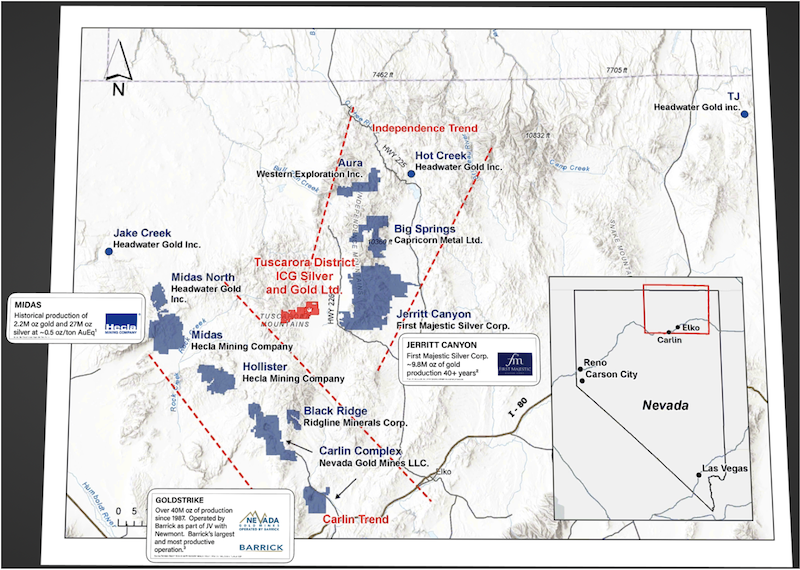 |
| Tuscarora sits in the same geological neighborhood as some of Nevada’s largest gold producers.
|
| ICG acquired its initial 8,000-acre position from American Pacific Mining, the project’s former operator, when it went public earlier this year. American Pacific retains just under 10% ownership of ICG, and the technical relationship between the two companies runs deep.
|
| Eric Saderholm, American Pacific’s own Co-founder and Managing Director of Exploration, now serves as ICG’s Senior Technical Advisor. Korbon McCall holds a Senior Project Geologist role at American Pacific while serving as ICG’s VP of Exploration.
|
| It is, in a sense, a continuity story: Many of the same geologists who worked this ground for American Pacific are now compiling everything they learned into ICG’s own district-scale model.
|
| Silver To The North, Gold To The South
|
| With a growing bank of exploration data and historic drill results, ICG’s geologists have been able to map for the first time a clear, previously unknown pattern in the district’s silver-to-gold ratios.
|
| The northern part of the property runs silver-dominant, with ratios as high as 150 grams of silver for every gram of gold. The southern part runs gold-dominant, closer to 10 to 15 to 1.
|
| Historically, the district was thought of as a gold play. It was only once the company's technical team laid decades of rock and soil sampling over the new geophysics that the silver values in the north stood out. Much of that historical drilling had been chasing gold in ground that was quietly running silver-rich the whole time.
|
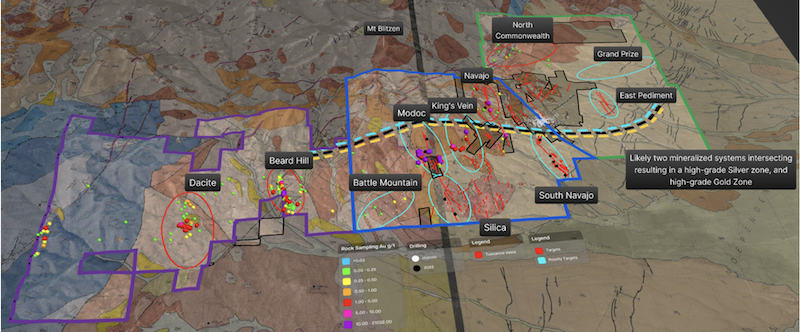 |
| The company's own target map shows the two systems converging through the heart of the property — right where the Modoc, King's Vein and Navajo targets sit.
|
| The company’s geologists now believe these may be two entirely separate mineralizing events colliding across the property, fed by structures tied to the ring fractures of the ancient Mount Blitzen Caldera itself.
The caldera sits directly adjacent to the district, and its ring structures extend across much of the property’s northern portion. Older calderas tend to give mineralizing fluids more time and more pathways to reach the surface...
...And ICG’s claims sit directly within that ring zone.
Even a single confirmed collision of two overlapping systems would be enough to justify years of follow-up drilling on its own.
|
| A 3,000-Meter Drill Program, Turning Now
|
| ICG’s Phase 1 drill program is underway now, testing targets across the Central and East Zones, with roughly 80% of the meters focused on the Central Zone, where the bulk of historical drilling sits.
|
| Four holes are already complete as of this writing, and assays are expected soon.
|
| And there’s much, much more ahead: South Navajo, Modoc and Silica, three of the district’s other priority targets, each represent kilometer-scale exploration opportunities in their own right.
Mineralization at several targets trends deeper with depth, and the district sits less than 1,000 feet from surface throughout, leaving the system open both laterally and at depth.
|
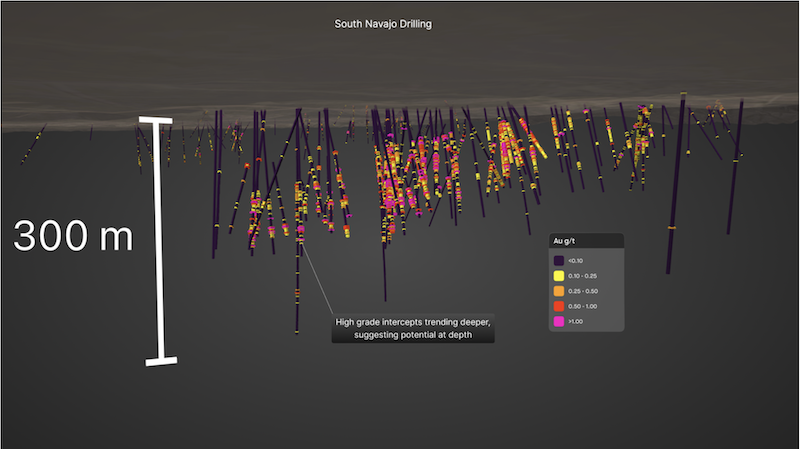 |
| The company's drill database shows confirmed gold mineralization at South Navajo trending deeper with depth, one of several targets across the district showing extensive, shallow mineralization that remains open at depth.
|
| A Company That Moves When It Sees Something
|
| ICG also has a pattern worth watching: When the company’s technical team spots something interesting beyond its existing boundary, it moves quickly to bring that ground into the project.
In April, the company’s technical team identified eight newly available mineral claims, ground with a history of reverse-circulation drilling that had never been fully compiled: 13 historical holes, six with assay data on record, including intercepts as high as 13.63 g/t gold over 1.6 meters.
|
| ICG staked it within weeks, named it the Battle Mountain target, and it is now the second priority in the current drill program, with one hole already completed there.
|
| Nine days later, the company moved again, on an even larger scale: A newly completed CSAMT geophysical survey pointed to a structural corridor extending onto ground west of ICG’s existing boundary — ground the company didn’t yet control.
ICG staked 104 additional claims covering roughly 2,000 acres to capture it, adding the TJ prospect to the Beard Hill and Dacite targets and, with them, potential Carlin-style host rock, with epithermal overprint, the district had never tested before. The timing lines up with renewed interest in the neighborhood: First Majestic Silver is restarting its Jerritt Canyon mine just 12 kilometers away.
|
| A Discovery Still Waiting To Be Priced In
|
| How does a company controlling 100% of a large Nevada district — sitting on more than 40,000 meters of compiled drilling that has intersected extensive gold mineralization across the property — carry a market capitalization of only about C$12 million?
|
| Other Nevada silver-gold explorers with established gold resource estimates are now trading for a considerable multiple of ICG’s market value.
|
| The good news is that previous drilling has already identified such extensive gold mineralization...and the current program is following up on so many historic drill holes and targets...that the company is set on commissioning its own resource estimate after the current drill program.
That should go a long way toward closing the valuation gap — especially when you consider that insiders hold over 25% of ICG’s tight share structure.
|
| The Catalysts Are Stacking Up...
|
| Assays from the first four completed holes are due shortly, and drilling continues across the Central and East Zones. More holes and more results are still to come.
|
| And a maiden resource estimate will follow once this phase of drilling wraps.
|
| ICG has hit every milestone on its original timeline since going public in March, and has grown its compiled drilling database by 60% in that time, from roughly 25,000 meters to more than 40,000.
The company has also shown a willingness to move fast on new ground, staking both the Battle Mountain and western expansion targets within weeks of identifying them, and its geologists believe the district’s West Zone could host Carlin-style/Epithermal mineralization never before tested on this property.
|
| The historical database alone is arguably worth more than ICG’s current market value. And proving the theory of two colliding mineral systems in the heart of Nevada...would be the kind of discovery that makes headlines.
|
| With drill results on the way — and potentially an entire new Nevada gold district in the making — the time to look deeper into ICG gold is now.
|
| CLICK HERE
To Learn More About ICG Silver & Gold
|


.png)


