|
| Sometimes the biggest move in a stock has nothing to do with the company behind it.
|
| That’s precisely what happened to Goldgroup Mining Inc. (GORO.V; GORO.NYSE) a few weeks ago, when a technical mechanism buried inside the world of stock index reconstitution triggered a wave of forced selling — all completely unrelated to the company’s mines, its cash flow or its growth plan.
|
| As you’re about to see, understanding why that selling happened — and why it had nothing to do with the business itself — is the key to this story…and the rare opportunity it now presents.
|
| When The Index Did The Selling…
|
| On July 17, Goldgroup Mining closed its merger with Gold Resource Corporation, the American producer behind the long-running Don David Gold Mine in Oaxaca, Mexico.
Under the terms of the deal, Gold Resource shareholders received 0.3619 Goldgroup shares for each share they held…and Gold Resource became a wholly owned subsidiary of the newly combined, Canadian-domiciled Goldgroup.
The merger combined Goldgroup’s Mexican gold assets with Gold Resource’s producing mine and its Back Forty development project in Michigan, creating a single company with no less than four 100%-owned assets and a dual listing on the TSX Venture Exchange and the NYSE American under the ticker GORO.
|
| But get this: Gold Resource had just been added to the Russell 2000 Comprehensive Factor Index after the annual Russell U.S. Indexes reconstitution took effect on June 26.
|
| FTSE Russell then determined the newly combined company no longer met the index’s nationality eligibility requirements — a classification tied entirely to Goldgroup’s Canadian home-country status — and notified the company it would be removed effective July 20, the very next trading session after the merger closed.
|
| The selling that follows a removal like this isn’t a discretionary decision made by any individual investor — it’s structural and automatic.
|
| Funds that track the Russell 2000 are required to hold whatever the index holds, and when a stock is dropped, those funds must sell their entire position within a tight window, regardless of valuation or the reason behind the removal.
The mandatory selling window drove the stock down by roughly 50% over about a week of trading, with the shares already beginning to recover from the selling in the weeks since.
|
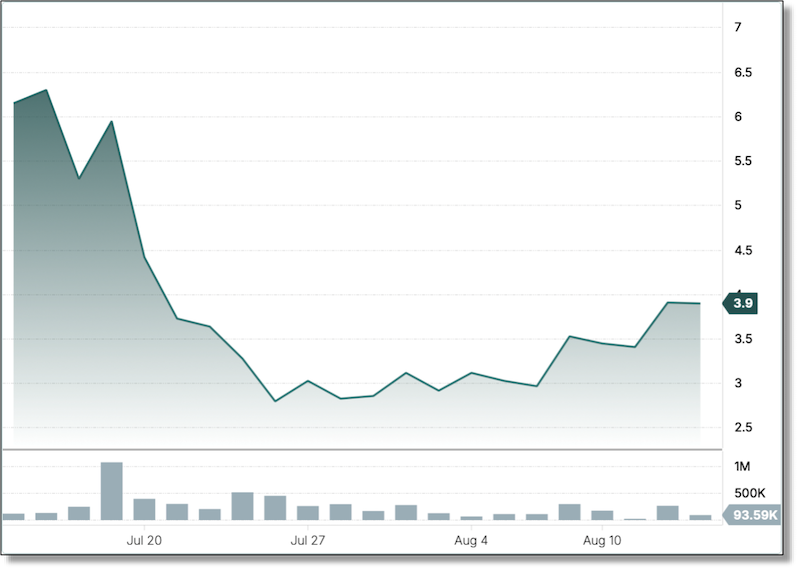 |
| The forced sell-off a few weeks ago halved Goldgroup’s share price — and it’s already begun to recover.
|
| Two Mines At Work Right Now
|
| Simply put, the index event was a distraction from what actually changed at Goldgroup: The company now controls a considerably larger, more diversified portfolio than it did just a month ago.
The flagship is the Don David Gold Mine, an underground operation in Oaxaca’s Arista district that hosts a structurally controlled epithermal vein system carrying gold, silver, copper, lead and zinc.
|
| The mine holds 1.5 million tonnes of Measured & Indicated resources grading 1.2 g/t gold and 167.3 g/t silver, with 2026 production estimated at approximately 38,000 ounces of gold-equivalent.
|
| The company has completed more than 23,000 meters of drilling at Don David so far this year — one of its largest campaigns there in recent years — across six underground rigs and one surface rig. Much of that work is aimed at upgrading the existing resource, with a further portion testing extensions of the vein system to expand it along trend.
|
| Alongside it sits Cerro Prieto, a heap-leach gold mine in Sonora producing since 2013 and expected to deliver another 16,000-plus ounces of gold this year.
|
| It also has three rigs currently drilling — two focused on resource expansion and one on confirmatory work supporting an updated mineral resource estimate — alongside sonic drilling planned to evaluate gold still contained in older heap-leach pads.
In other words, there will be lots of news flow from these two mines. And then there’s….
|
| A Past Producer’s Second Act
— And A Giant Still Waiting
|
| The nearest-term growth catalyst is San Francisco, a past-producing open-pit gold project in Sonora that Goldgroup fully owns and that remains fully permitted for a rapid restart.
This is a big project: An updated technical report puts the project’s current Measured & Indicated resource at 1.23 million ounces of gold, and drill rigs are turning as part of a 24,000-meter program designed to confirm the resource model ahead of its upcoming targeted restart.
|
| Once running, San Francisco is expected to add 40,000 to 60,000 ounces of gold equivalent per year on a life-of-mine average basis.
|
| Beyond that lies Back Forty, a gold-rich volcanogenic massive sulphide project in Michigan carrying 14.5 million tonnes of Measured, Indicated and Inferred resources grading 2.21 g/t gold, 27 g/t silver, 0.38% copper and 3.35% zinc.
Based on the project’s 2023 preliminary economic assessment, Back Forty carries an after-tax net present value of US$214 million at a base-case gold price of US$1,800/oz, rising to US$556 million under a consensus-pricing scenario averaging US$3,036/oz gold.
That latter number is much higher than Goldgroup’s entire market cap at this moment.
|
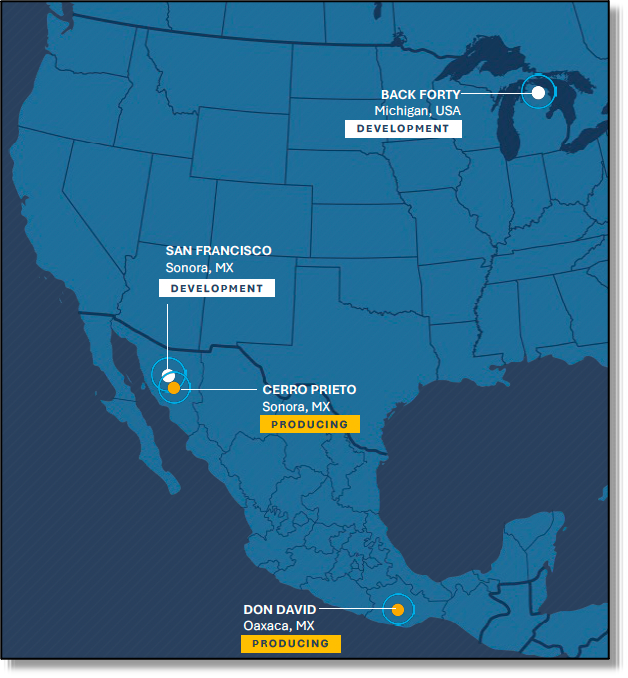 |
| Four 100%-owned assets across two countries give Goldgroup a rare combination of current production, near-term restart potential and long-term development upside.
|
| Together, Don David, Cerro Prieto and San Francisco give Goldgroup a near-term combined production estimate of roughly 100,000 ounces of gold equivalent annually.
From there, the company has outlined a longer-term target of 250,000 ounces through a combination of organic growth — optimizing existing operations and advancing Back Forty toward development — and future acquisitions, per its stated growth strategy.
This is a much bigger gold producer in the making…in the midst of perhaps the most exciting gold bull market in history.
|
| All Of That, On Sale?
|
| So what happens once the mandatory selling works its way through the system and ordinary buyers and sellers go back to setting the price?
That’s the real question. Goldgroup closed its merger with roughly US$46 million in cash and zero debt, four 100%-owned assets spanning current production and near-term growth, and a dual listing that broadens its reach across Canadian and U.S. capital markets.
The company’s shareholder base also includes one of the world’s most successful gold mining investors — Eric Sprott — who added to his position through the merger and now controls more than 10 million shares.
|
| None of that changed when FTSE Russell applied its nationality rule — what changed was a temporary supply-demand imbalance created entirely by portfolio mechanics.
|
| Once San Francisco reaches its targeted production range, Goldgroup’s combined output could place the company alongside a group of intermediate producers, several of which carry market capitalizations well above US$1 billion, according to the company’s own peer comparison.
A forced seller isn’t making an investment decision. It’s following a rulebook, on a deadline, regardless of price.
|
| For Goldgroup Mining, that rulebook created a gap between a short-lived technical event and a company that just tripled its asset base through a transformational merger.
|
| Now is the moment to take a closer look at what the index-driven selling left behind.
|
| CLICK HERE
To learn more about Goldgroup Mining
|


.png)


