| CLICK HERE
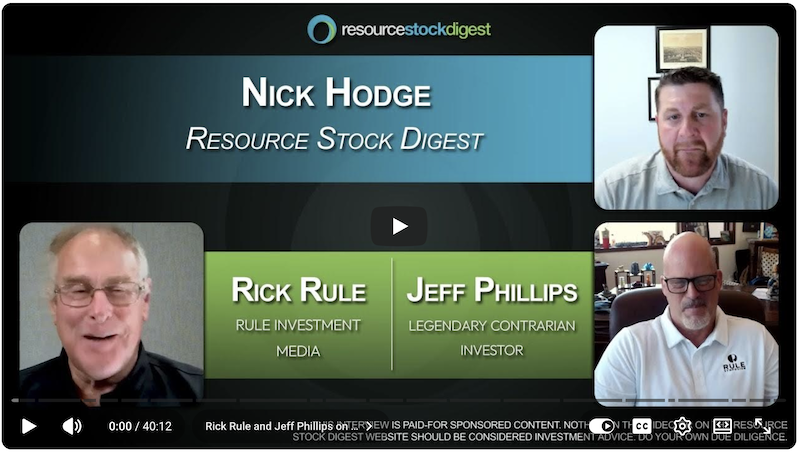
To watch Rule and Phillips break down why the prospect generator model — and Headwater Gold specifically — gives investors more shots on goal with less dilution.
|
| CLICK HERE
To watch CEO Caleb Stroup outline Headwater Gold’s key advantages in its business model, share structure and projects.
|
| Two major gold companies drilled the same junior’s ground at the same time this summer.
|
| That junior is Headwater Gold Corp. (HWG.CSE; HWAUF.OTCQX), where Rick Rule and Jeff Phillips are both shareholders today.
|
| Between them, Newmont, OceanaGold and Centerra Gold fund exploration on seven of Headwater’s projects across Nevada and Idaho, while Headwater advances the rest of its portfolio on its own, with OceanaGold’s and Centerra Gold’s rigs turning simultaneously this summer.
Rule has backed prospect generators — companies built to let other people pay for the drilling — for nearly 50 years. Here’s how that plays out inside Headwater’s own project list.
|
| A Model Built To Let The Majors Do The Spending
|
| Headwater’s technical team stakes and advances a large portfolio of 100%-owned projects across prime exploration ground in Nevada and Idaho, then brings in major partners once a target is proven up enough to justify serious money.
This strategy allows the majors to fund the most expensive exploration efforts…which means Headwater doesn’t have to dilute its share structure to fund those efforts on its own.
|
| This is why Headwater can run roughly a dozen projects at once while keeping its own overhead low — its Newmont and OceanaGold earn-ins each come with a 10% management fee that helps offset corporate costs.
|
| Rule was introduced to Headwater through EMX Royalty, a prospect generator he has followed for 25 years. Phillips came to it through respected independent geologists Brent Cook and Joe Mazumdar, and grew into a larger shareholder after getting to know President and CEO Caleb Stroup’s technical team.
|
| Seven Projects Backed by Three Majors
|
| Newmont has already taken Headwater’s Spring Peak project through a formal joint venture agreement after funding its way to a majority interest there, and separately funds exploration at Headwater’s Lodestar project.
This year, Newmont strengthened the partnership by adding a third Headwater project: Jupiter, a district-scale target in the Walker Lane belt that Headwater staked entirely on its own...and turned into a Newmont-funded earn-in within months.
OceanaGold is funding three more Headwater projects — TJ, Jake Creek and Hot Creek — under a deal that can reach $65 million in staged exploration spending. The rig turned at Jake Creek this summer, testing new epithermal targets near Nevada Gold Mines’ Turquoise Ridge complex.
Centerra Gold, already a strategic shareholder, signed on for a fourth partnership at Headwater’s Crane Creek project in Idaho, where its rig turned at the same time — the first drilling on that project since the 1990s.
|
| The results are backing up the interest. This past year’s drilling at TJ returned the highest gold grades to date at the project, and the company followed up by expanding its land position there by 88%.
|
| So what happens when three major gold companies are all funding one junior gold explorer at the same time? According to Rule and Phillips, that’s precisely the setup worth paying attention to before the broader market fully catches on.
|
| Three major partners. Over $200 million in potential funding. Two drill programs turned simultaneously this summer. A structure built specifically to keep dilution low while other people’s money makes the discoveries.
|
| Watch the videos below to hear why Rule and Phillips backed this model with their own capital, then judge for yourself whether Headwater belongs on your radar.
|


.png)