|
| Over the past several months, we have been following one of the most compelling stories in the junior resource space.
|
| And the story keeps getting better.
It centers on a multi-million-ounce gold-copper porphyry in Ecuador’s Zamora belt, advanced by the same team that founded Silvercorp Metals.
And remarkably, despite that heritage and rapid growth…it’s currently trading at a dramatic discount to peers.
|
| Consider this: Since we first introduced it in May, the drill program at Santa Barbara has delivered results in four successive batches — and each one has added significantly to the picture.
|
| With the most recent batch, the grades have taken a big step up. And with more holes on the way, the information flow is far from over.
|
| A Drill Program That Keeps Raising The Bar
|
| Every hole in Santa Barbara’s Phase 1 drill program has returned gold-copper mineralization, with the majority delivering wide, continuous intercepts that continue to build the case for a larger, higher-grade resource.
The program opened in June with Hole 54: 705.7 meters grading 0.61 g/t gold from surface, including 235 meters at 0.97 g/t gold, ending in mineralization. It set the tone for everything that followed.
The second batch, released July 13, added Hole 59: 625.12 meters at 0.64 g/t gold starting from 81 meters, also ending in mineralization — a gold grade roughly 23% above the inferred resource average.
The third batch, released July 28, brought four more hits, including high-grade pockets in Hole 62 (29.4 meters at 1.53 g/t gold) and Hole 63 (36.5 meters at 1.25 g/t gold from surface).
|
| Then came the fourth batch, released August 18 — and it raised the bar yet again.
|
| Hole 61 intersected an amazing 496.5 meters grading 0.76 g/t gold and 0.12% copper from 88.5 meters, including a 212.5-meter high-grade zone grading 1.12 g/t gold and 0.14% copper.
|
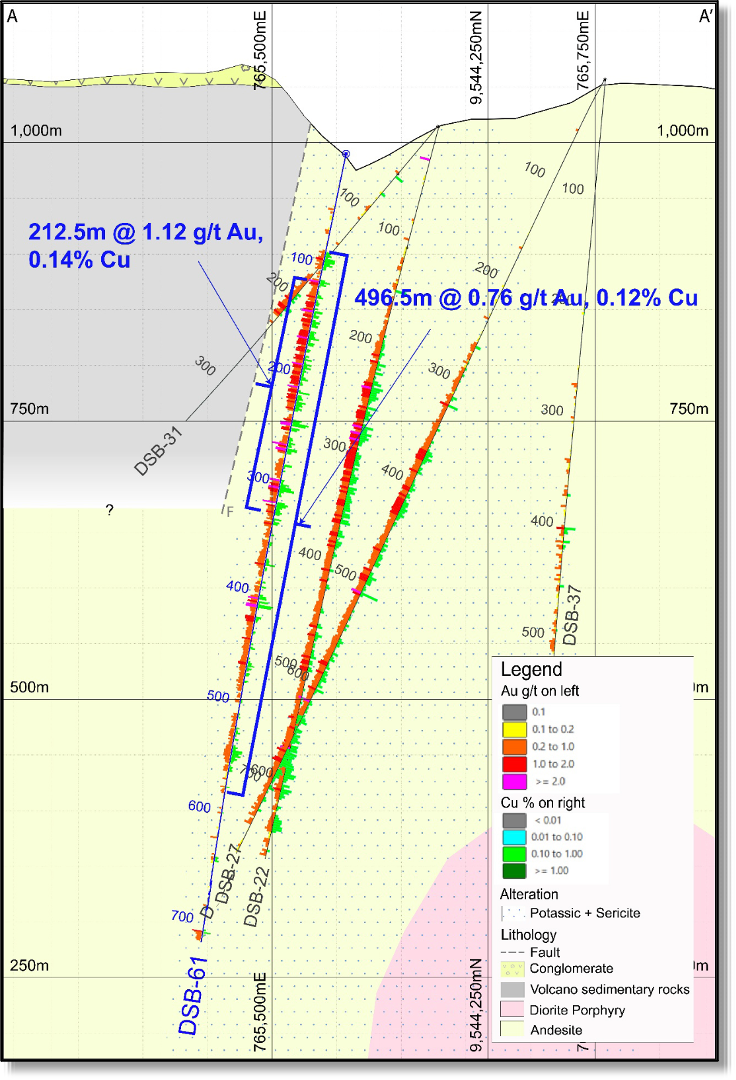 |
| Hole 61 returned 496.5 meters of continuous gold-copper mineralization, with a 212.5-meter high-grade core grading more than double the existing inferred resource average — the strongest intercept the program has yet delivered.
|
| That headline interval is nearly a half of a kilometer carrying a gold grade about 46% above the inferred resource average. The high-grade zone within it runs approximately 115% above the inferred resource average — the highest gold grade the program has yet reported.
Hole 67 added 380 meters grading 0.71 g/t gold and 0.10% copper from just below the surface overburden — another long, consistent intercept with gold grades above the inferred average. Hole 66 returned 287 meters at 0.51 g/t gold from surface.
Now 14 holes in. Every single one a hit. And the grades are trending higher.
|
| LATE UPDATE
|
| Auro has just released three more holes, and the upgrading trend has continued. The results are highlighted by Hole 68 cutting a remarkable 905.22 meters running 0.60 g/t gold and 0.12% copper.
As CEO Victor Feng notes, “These results, along with the previously reported intercepts, continue to demonstrate that mineralization is open up-dip, down-dip, and at depth. Hole 68 is the longest and deepest hole drilled at Santa Barbara. On a gram by meter basis, it returned the best reportable intercept at the Project to date, including all historical drilling. The hole remained mineralized to the end at a depth of 1,282 meters, showing mineralization is open at depth.”
|
| The Santa Barbara project just keeps getting better and better.
|
| Santa Barbara:
Scale That Demands Attention
|
| For readers encountering this story for the first time, here is the context…
Santa Barbara sits in the Zamora Copper-Gold Belt in southeastern Ecuador — the same neighborhood monster deposits like Lundin Gold’s Fruta del Norte mine, the Mirador copper-gold mine and Solaris Resources’ Warintza deposit.
|
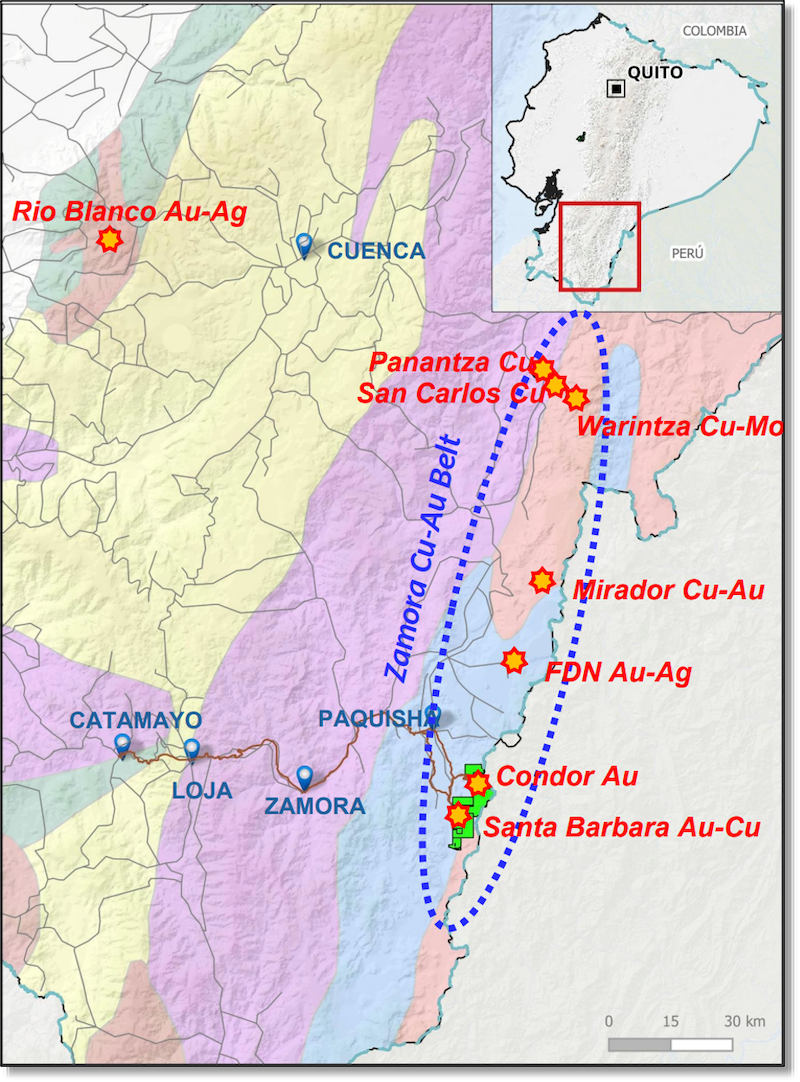 |
| Auro’s Santa Barbara project is located in the renowned Zamora Copper-Gold Belt and is surrounded by numerous high-profile mines and projects.
|
| Over the past two years, that belt has seen over $1.5 billion in M&A activity, with major and state-owned acquirers targeting precisely the kind of large-scale, technically credible copper-gold porphyry that Auro controls.
The remaining inventory of such assets is finite — and Santa Barbara is one of them.
And it’s big. This gold-copper porphyry boasts an existing NI 43-101 resource of 697,000 ounces of indicated gold at 0.73 g/t and 3.42 million ounces of inferred gold at 0.52 g/t.
|
| Combined with copper, the total gold-equivalent resource is approximately 4.3 million ounces — and that’s all before any of the current drill program’s results have been incorporated.
|
| That resource was built on just 56 holes over three decades of intermittent work, with no drilling at all since 2018…until now. And Auro’s Phase 1 program is already delivering results that suggest the next resource estimate could look materially different.
|
| The Grade Story
|
| What makes the most recent batch particularly significant is what it says about where the grades are heading.
Phase 1 was designed as an infill program to upgrade inferred ounces to indicated — systematically filling gaps between historical holes to build confidence in the resource. That alone would be a meaningful technical de-risking event.
But the emerging grade picture suggests Phase 1 may deliver something more.
|
| The inferred resource grades at 0.52 g/t gold. Across 14 reported holes, grade consistency has been strong throughout the program. And in Hole 61, a 212.5-meter zone came in at 1.12 g/t gold — more than double that average.
|
| Auro CEO Victor Feng flagged the implication directly in the company’s August 18 news release, citing the program’s potential to “improve overall gold grades in a future resource update.”
A resource update that incorporates both additional ounces and higher average grades would represent a genuine step-change in how the market values this asset.
|
| Still More To Come…
|
| So far, 22 Phase 1 holes have been completed, and only 14 have been reported.
Results for the other eight holes are on the way, with releases coming as they become available.
Each hole is a potential catalyst.
Here’s where it gets interesting: After Phase 1 wraps, Phase 2 steps out to extend the resource envelope — expanding laterally and at depth. Phase 3 would continue testing the outer limits of the deposit and build off of Phase 2 drilling.
|
| The company has two phases of drilling funded and ready to execute sequentially.
|
| In other words, Auro is not running out of news flow anytime soon.
|
| The Team That Can Take This All The Way
|
| None of this would carry the same weight without the right team in place. Auro is built by the same individuals who founded and grew Silvercorp Metals from a grassroots explorer into one of the world’s most consistently profitable silver-gold producers — a company that went from junior to multi-mine producer generating consistent free cash flow and dividend payments.
|
| That is a full cycle: exploration to discovery to resource definition to production. The Auro team has done it before, and they are applying that same institutional playbook here.
|
| Dr. Rui Feng, founder of Silvercorp and New Pacific Metals, is the architect of this enterprise. CEO Victor Feng — a Silvercorp and New Pacific Metals veteran — is at the steering wheel, while Director and Qualified Person Alex Zhang, with 30 years of exploration experience across Silvercorp and other major miners, oversees the technical program.
This is the same institutional apparatus that built Silvercorp, now applied to a large-scale porphyry system with a defined multi-million-ounce resource, active drill rigs turning and incoming results that keep raising the ceiling on what this project could become.
|
| What This Means For Investors
|
| So when you consider what Auro now represents — 14 drill hits, headline intercepts measuring in the hundreds of meters, grades trending above the existing resource average and eight more holes still to report — the question becomes whether the market has had time to fully absorb what is being built here.
|
| Consider that the existing 4.3-million-ounce resource was established before a single meter of the current drill program.
|
| Phase 1 alone could materially change the size and grade profile of that resource.
Phase 2 could extend it further. Phase 3 could reveal something new entirely.
Here is what investors are looking at:
|
| • 14 drill holes, every one returning gold-copper mineralization — the majority wide and continuous
• The program’s best result yet: 496.5 meters at 0.76 g/t gold including 212.5 meters at 1.12 g/t gold (UPDATE: 905 meters of 0.60 g/t gold and 0.12% copper!)
• Grades trending above the existing inferred resource average across successive batches
• Eight holes still awaiting assay results from an ongoing four-rig program
• An ongoing, fully funded three-phase drill program stretching well into 2027
• A 4.3-million-ounce gold-equivalent resource not yet updated to reflect any of the current results
• A Silvercorp-pedigree team that has taken a junior company all the way through to producing mine
|
| Auro’s market cap does not yet reflect what this drill program is building toward. The next eight holes may help change that.
|
| CLICK HERE
To Learn More About Auro Metals
|


.png)


