|
| For most of the last century, Inco. maintained a dominant exploration and mining presence in Ontario’s Shebandowan Greenstone Belt
|
| The nickel giant mined there from 1972 to 1998, and the district became known as a copper-nickel belt. Gold was an afterthought...and the region saw very little gold exploration for decades.
That has changed dramatically.
|
| Gold explorers have moved in…major producers are following…and Delta Resources (DLTA.V; DTARF.OTC) controls a 340-square-kilometer land package at the center of it all, just 50 kilometers west of Thunder Bay.
|
| Better still, Delta is advancing on two fronts at once: It is growing its Eureka gold deposit toward a maiden resource estimate and drilling the high-grade I-Zone target for the first time.
|
| A Forgotten Belt Wakes Up To Gold
|
| When explorers finally took a serious look at the Shebandowan Belt for gold, they found plenty of it.
|
| More than 10 million ounces of gold resources have now been defined across the belt.
|
| For example, Gold X2 Mining’s Moss Lake deposit, 50 kilometers west of Delta’s Eureka deposit, hosts 2.12 million ounces Indicated and 3.91 million ounces Inferred. And Thunder Gold’s Tower Mountain project, just 10 kilometers east of Eureka, holds 0.51 million ounces Indicated and 3.05 million ounces Inferred.
The majors are writing checks, too. Gold X2 raised more than C$115 million earlier this year, including a significant strategic investment from AngloGold Ashanti.
|
| A Growing Gold Discovery With Infrastructure
|
| Delta’s flagship asset is the large 340-square-kilometer Delta-1 Project just west of Thunder Bay, Ontario. This large land package has the potential to yield a number of significant gold discoveries.
The Delta-1 project is anchored by the Eureka Gold discovery.
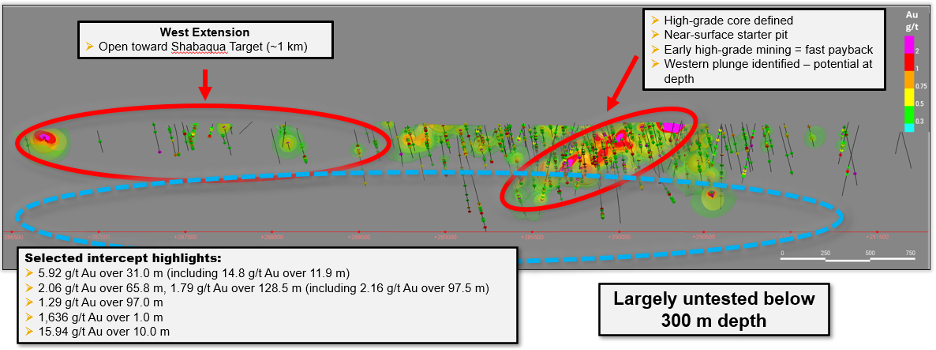
More than 48,000 meters have been drilled at Eureka since 2019. That drilling has outlined Eureka over 2.5 kilometers of strike so far, from surface to 300 meters vertical depth, with true widths of 10 to 100 meters.
|
| Mineralization has been intersected as deep as roughly 600 meters — and the mineralization remains open in all directions.
|
| The widths are impressive as well. Highlights include:
|
- 5.92 grams per tonne (g/t) gold over 31.0 meters, including 14.8 g/t over 11.9 meters.
- 1.79 g/t over 128.5 meters, starting just 25.5 meters down the hole, including 2.16 g/t over 97.5 meters.
- 2.06 g/t over 65.8 meters, including 4.23 g/t over 26.2 meters…and many more.
|
| Earlier this calendar year, Delta successfully drilled 1.5 kilometers west along strike from the Eureka gold deposit. The target, known as the Shabaqua Zone, shows the potential to join up with Eureka as one large open pit.
More drilling at Shabaqua is expected as part of the current drill campaign already under way.
Multiple gold intercepts at the Shabaqua Target included:
|
-
4.25 g/t gold over 11.8 meters
-
1.37 g/t gold over 10.5 meters
-
2.40 g/t gold over 4.3 meters
|
| |
| In addition to Eureka’s growing, multi-kilometer strike length, its higher-grade core remains open at depth — and that’s a prime target of the new drill program.
|
| The Eureka discovery carries higher-grade gold as well.
Drilling has returned 15.94 g/t over 10.0 meters and bonanza-grade intervals as high as 1,636 g/t gold over 1.0 meter. And infill drilling reported in February added 4.18 g/t over 17.7 meters from the heart of the mineralization.
Location may be Eureka’s greatest asset though. The Trans-Canada Highway runs right past the project. Two power lines are already on the property with a third high-voltage line being built, and the CN rail line crosses the property. Crews can commute daily from Thunder Bay, and the site is free of lakes and rivers.
In short, the economics of Eureka go far beyond just the metal in the ground.
|
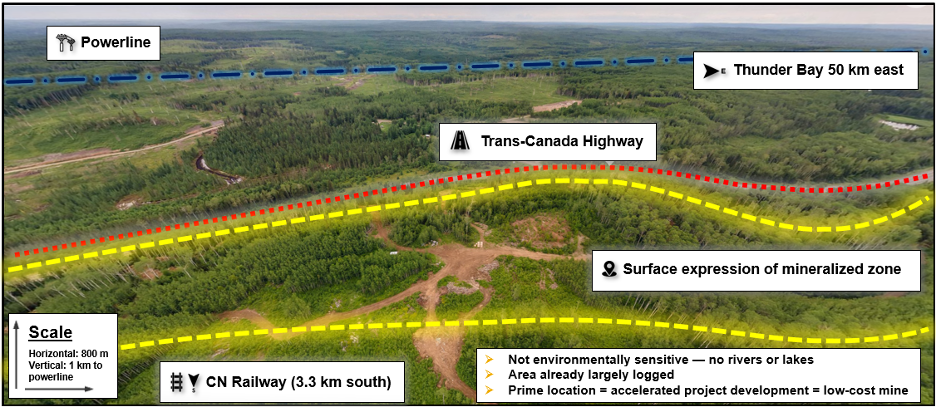 |
| Delta-1 lies in the midst of the infrastructure-rich Thunder Bay mining jurisdiction, and features next-level transportation and power access due to its proximity to the Trans-Canada Highway and the CN Railway network.
|
| In parallel with its aggressive exploration program, Delta is advancing metallurgical test work and environmental baseline studies, important steps in de-risking and advancing the Delta-1 Gold Project.
The recent addition to the board of Joseph Milbourne, a metallurgical expert with more than 50 years of experience, brings particularly relevant expertise as this work advances. Milbourne was joined on the board by Zach Flood, Co-Founder and CEO of Kenorland Minerals.
These impressive new Board additions join Dr. Kevin Heather, Chief Geological Officer (CGO) for Regulus and Aldebaran, and Sara Paquet CEO of Kluane Drilling Ltd., one of the world’s top 10 drilling services companies with operations in Canada, Mexico, Central America, South America and Africa.
Attracting professionals of this caliber to the board is a strong endorsement of the quality, scale and potential of the opportunity and provides independent technical and corporate governance expertise as Delta advances.
Next on the list is a maiden NI 43-101 resource estimate, which will provide the market with its first formal estimate of the size and grade of the Eureka gold project.
|
| A High-Grade Story Interrupted In 2008
|
| About 18 kilometers southwest of Eureka lies another target with an intriguing history.
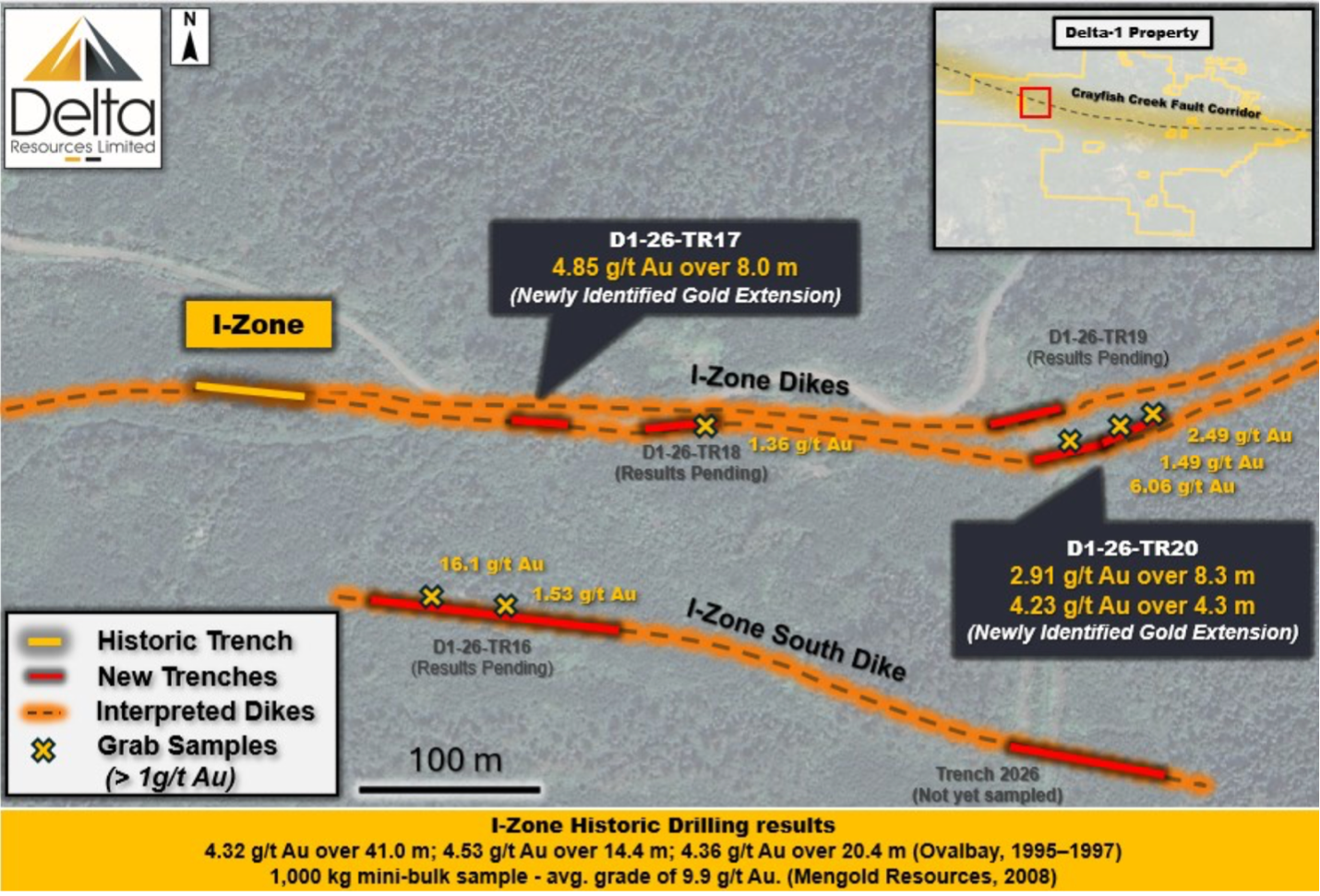
In the late 1980s, Inco uncovered as many as 13 gold-bearing dikes at the I-Zone. Drilling in the mid-1990s returned 4.32 g/t gold over 41.0 meters, 4.53 g/t over 14.4 meters and 4.36 g/t over 20.4 meters.
And in 2008, Mengold Resources took a 1,000-kilogram mini-bulk sample that averaged 9.9 g/t gold. (All are historical results and not NI 43-101 compliant.)
Then the financial crisis hit...and Mengold never returned.
|
| In August, Delta completed its acquisition of 100% of the Gold Creek property hosting the I-Zone, settling its final share obligation in cash to avoid dilution.
And with 10 geologists in the field for the largest program in company history, the payoff came quickly….
|
| Channel sampling extended known I-Zone mineralization by more than 400 meters to the east, including 4.85 g/t gold over 8.0 meters and 2.91 g/t over 8.3 meters. The zone remains open along strike in both directions and largely untested at depth.
|
| |
| Click image to enlarge
Summer fieldwork extended I-Zone high-grade gold mineralization by more than 400 meters.
|
| And the I-Zone is just one target. Along the broader Crayfish Creek Fault corridor, Inco identified more than two dozen high-grade mineral occurrences, including historical grab samples as high as 759 g/t gold. Many have seen little or no systematic follow-up.
As CEO Ron Kopas put it, “we are only beginning to understand the scale and potential of this system.”
|
| Two Fronts, One Fully Funded Program
|
| On September 22, Delta launched a 10,000-meter drill program targeting both stories at once.
At Eureka, step-out holes will test the interpreted westward plunge of the higher-grade core at depth. They will also test the deposit’s continuity west toward the Shabaqua target, where earlier drilling hit 4.25 g/t gold over 11.8 meters.
And at the I-Zone, Delta’s first-ever drill holes will test the newly extended trend along strike and at depth.
Add hundreds of surface samples still awaiting assays, and the stage is set for steady news flow from two fronts in the months ahead.
|
| Delta’s 2026 exploration program is fully funded, following an oversubscribed C$6.56 million flow-through financing in May.
|
| On top of that, Troilus Mining has optioned Delta’s Delta-2 property in Quebec for up to C$8.25 million in staged payments over three years, with Delta retaining a 1% net smelter return royalty. Troilus funds all Delta-2 exploration during the option period, and Delta has already received C$1.75 million.
Interests are aligned, too: CEO Ron Kopas is Delta’s largest individual shareholder...and he works for $1 a year.
|
| Getting In On The Ground Floor Of A New Gold Camp
|
| Step back and consider the full picture.
Delta has a multi-kilometer-long and growing gold project working toward its first resource estimate…a high-grade second front being drilled by Delta for the first time…and a district-scale land package in a camp where majors are committing serious capital.
Yet Delta’s market capitalization stands at roughly C$33 million today. The Troilus option alone could deliver up to C$8.25 million, about a quarter of that figure.
|
| That leaves a remarkably modest value on everything else Delta has built at Delta-1. And once a maiden resource puts a first official number on Eureka, investors will have a concrete yardstick to weigh against it.
|
| With drills turning on two fronts and a maiden resource ahead, now is the moment to get to know Delta Resources.
|
| CLICK HERE
To learn more about Delta Resources
|