|
| One of this year’s biggest rare earth stories hit the market disguised as a defense deal.
|
| In September, President Trump signed a security agreement with Denmark and Greenland. On paper, it covers Arctic bases and defense.
But lawmakers were quick to point out what makes the island so strategic, with Rep. John Moolenaar calling Greenland home to critical minerals “that will power the future.”
|
| Investors connected the dots almost instantly. As the deal came together, associated rare earth companies soared: Greenland Mines nearly quintupled in two trading days...and Critical Metals jumped almost 39% in a single session.
|
| That’s the pace this sector moves at now. And while the world watched the Arctic, Tactical Resources (TREO.NASDAQ) has been advancing a rare earth project that’s 100% on American soil, built around material that has already been mined.
As you’re about to see, the timing could hardly be better.
|
| Two Deadlines Approaching Quickly
|
| China refines roughly 91% of the world’s rare earths and makes 94% of the sintered magnets that go into fighter jets, precision-guided weapons and EV motors.
|
| And Beijing has shown it will use that leverage, tightening export controls again and again. In June, it placed 10 U.S. companies on its export control list, including USA Rare Earth, Tactical’s neighbor in West Texas.
|
| The trade truce struck in October 2025 paused China’s broadest rare earth restrictions. That pause now runs only to January 10, 2027.
And nine days before that, on January 1, a Pentagon rule takes effect barring defense contractors from supplying rare earths mined, refined or separated in China.
Put those two dates together, and the pressure on America’s rare earth supply could build fast.
Washington has already started writing checks, including a $400 million investment that made the Pentagon MP Materials’ largest shareholder.
|
| Rare Earths
...Already Out Of The Ground
|
| Tactical’s Peak Project sits inside the active Sierra Blanca Quarry in Hudspeth County, West Texas, southeast of El Paso. For two decades, the quarry has crushed rock into railway ballast for Union Pacific.
The coarse rock gets sold. The fine material, crushed to less than 3.2 millimeters, has piled up on surface with zero value to the quarry.
To Tactical, that fine material is potential rare earth feedstock that’s already been mined, crushed, conveyed and stockpiled...years of work and cost that any greenfield project still has ahead of it.
|
| Tactical owns approximately 1.5 million tonnes of that material outright.
|
| Its agreement with the quarry covers roughly four million tonnes in total, plus rights to fines produced going forward and an exclusive option to acquire 100% of the quarry operation itself. (Note that while no mineral resource has been estimated yet, these tonnages come from Tactical’s commercial agreements.)
The neighborhood is impressive, too. Peak lies just two miles from Round Top, the heavy rare earth project operated by USA Rare Earth, inside the same geological complex.
|
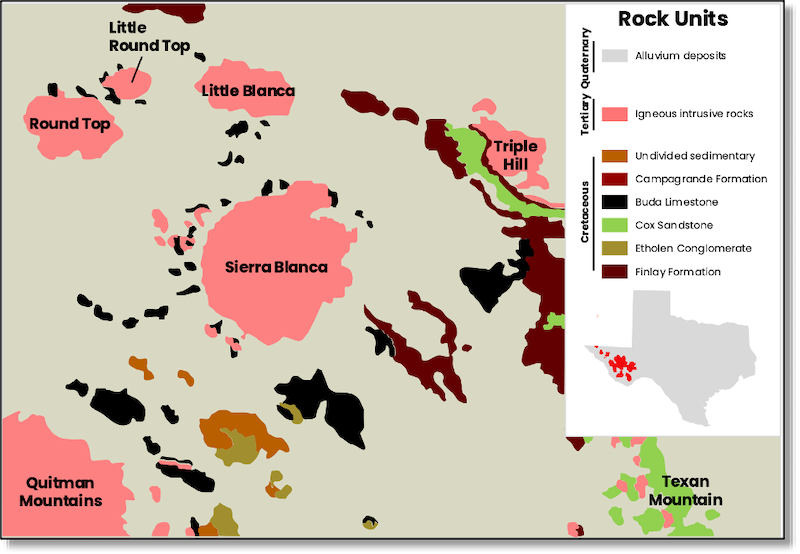 |
| Peak sits in the same geological complex as the massive Round Top rare early complex...just two miles away.
|
| And Washington has made its view of USA Rare Earth very clear. The Commerce Department has committed a $1.6 billion funding package to the company and is taking an equity stake in it.
That’s a billion-dollar federal bet placed right next door to Peak.
Peak also comes with road access, a rail spur, power and quarry operating permits already in place.
|
| A Shortcut Past The Hardest Step
|
| For most rare earth projects, the toughest challenge comes after mining. Conventional processing leans on caustic cracking, acid baking and intensive heat treatment, the most technically demanding and highest-risk part of most projects.
|
| It’s also the step the West has long left to China.
|
| Peak’s mineralogy may offer a way around it. The project is one of only a few hard rock rare earth projects in the world amenable to direct leaching, which could let it skip much of the high-temperature roasting and cracking that comes before extraction.
|
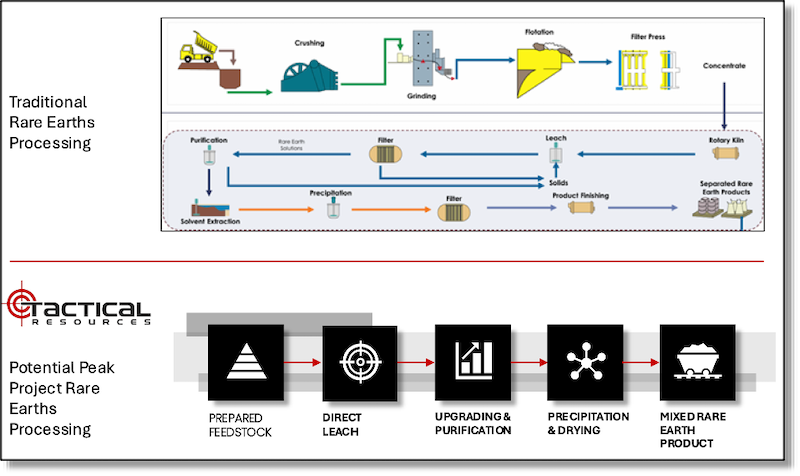 |
| Direct leaching could cut out the complex and expensive roasting and cracking stages that define most rare earth processing.
|
| Early independent tests back that up, extracting up to 96.1% of the rare earths at scoping scale.
The material also leans heavy, with heavy rare earths averaging more than twice the light ones. Heavies like dysprosium and terbium keep magnets working at high temperatures...and they’re where the U.S. supply chain is most exposed.
|
| From Stockpile Toward Magnets
|
| Here’s where the story gets especially timely. Tactical began trading on Nasdaq on August 20, opening the door to U.S. capital markets...and it’s wasting no time.
The company is moving Peak into its next phase: finalizing Phase 1 metallurgical results, advancing process development, building permitting and environmental roadmaps, expanding exploration and growing downstream partnerships.
|
| Its roadmap runs through a scoping study and demonstration plant toward commercial start-up.
|
| And it’s setting a fast pace, aiming to show progress on processing, separation and magnet-ready products by next summer.
|
| What A Head Start Is Worth
|
| The Greenland rally showed how much investors value rare earth exposure tied to U.S. security...even on an island thousands of miles from American soil.
Tactical Resources still carries a market value of only about $22.5 million.
That $22.5 million buys exposure to:
|
| • A rare earth project 100% on American soil, two miles from one of Washington’s flagship rare earth bets
• Roughly 1.5 million tonnes of owned, already-mined material sitting at surface
• Early tests pointing to a simpler, leach-based processing route
• A heavy rare earth profile aimed at America’s biggest supply-chain vulnerability
|
| ...all arriving as January’s twin deadlines close in.
Before the next rare earth headline lands closer to home, it’s time to take a hard look at Tactical Resources.
|
| CLICK HERE
To learn more about Tactical Resources
|